You’re not alone if you’ve ever felt like the system’s just not built for real-life emergencies. Across the U.S., people are facing mental health crises every day, yet many don’t get the help they need in time. One in five adults lives with a mental illness, and when a call comes in, it’s often law enforcement that shows up, not a trained mental health team.
You’ve probably seen it happen if you work in healthcare, public safety, or support services. The gaps are real. And when the only options are the ER or a jail cell, things fall through. That’s why more communities are asking: What is a mobile crisis response team, and how can it help?
At AVAN Mobility, we’ve spent over 10 years building more than 150 mobile medical units that help teams like yours show up differently. From CalOptima to Pacific Clinics, we’ve worked with organizations across the country that care deeply, just like you do. We’re a Ford Pro Upfitter and Stellantis QPro-certified, and we build with one thing in mind: helping people get care with dignity.
In this article, you’ll learn:
- The state of crisis response in the U.S.
- What barriers exist today
- What a mobile crisis response team is
- Which mobile units support these programs
What does the data show about mental health crises in the U.S.?

You might be asking: With all the stories and headlines, what does a mobile crisis response team see in the real numbers? Let’s get into that, because knowing what’s happening helps you see where mobile crisis response teams fill the most urgent gaps.
- Prevalence of mental illness: Nearly 23% of U.S. adults (about 60 million people) had a mental illness in the past year. Over 13 million people reported serious thoughts of suicide.
- Youth under‑treatment: Among ages 12‑17, one in five experienced at least one major depressive episode, yet more than half of them didn’t get any treatment.
- Workforce and access issues: There’s a growing shortage of behavioral health professionals. Many areas have few providers, long wait times, or high costs, which people can’t afford.
What does crisis response look like today?
Because of these gaps, the “default” response often includes:
- Emergency departments (EDs): When someone is in a crisis, they often end up going to a hospital. But many EDs are overcrowded and not always equipped for mental health emergencies. Some people wait hours or even days for psychiatric beds.
- Law enforcement involvement: Police often respond, even if the issue is behavioral health. That can escalate situations, especially if officers lack mental health training.
- Hotlines (like 988): These are critical for talking people through crisis moments, but follow-up and in‑person help are uneven across states.
5 biggest barriers to getting help during a mental health crisis
So, we’ve talked about what the data says. We’ve looked at how the current response system works. But here’s the next big question: why is it still so hard for people to get help when they need it most?
Even when someone is ready to reach out, a long list of barriers can get in the way. And let’s be honest, during a crisis, those barriers don’t feel like speed bumps. They feel like brick walls.
Here are the five biggest reasons people across the U.S. fall through the cracks during a mental health crisis:
1. Lack of transportation
Let’s start with the obvious: If you can’t get there, you can’t get help.
- Many people in both urban and rural areas don’t have access to a personal vehicle
- Public transportation is either unreliable, too expensive, or unavailable at the wrong time
- In a crisis, you can’t wait for a bus that might not show up, and ambulances aren’t always a fit for behavioral health
Bottom line: Getting to a clinic or hospital isn’t realistic for a lot of people, especially in moments of crisis.
2. Long wait times
Let’s say someone makes it to a hospital or mental health center. Now what?
- Many clinics are booked out for weeks, and emergency departments are overloaded
- According to the CDC, 70% of mental health-related ED visits ended with people being sent home or admitted after waiting hours or days
- For youth, delays are even worse. One study found the average wait for adolescent inpatient care in the U.S. is over 10 hours
In a crisis, time is not a luxury.
3. Stigma and fear of judgment
Mental health still carries a heavy stigma, especially in tight-knit communities
- People fear being judged by friends, family, or even care providers
- In some cultures, mental illness is misunderstood or not openly discussed
- This fear can stop someone from reaching out, even if they desperately want help
The result? Silence, and sometimes, tragedy.
4. Cost and insurance barriers
Money shouldn’t be what decides whether someone gets help, but it often is
- Many people don’t have insurance, or their plan doesn’t cover behavioral health
- Even with coverage, co-pays and deductibles can be hundreds of dollars per visit
- Community-based crisis services are rare, especially ones that are free
If help is available but unaffordable, is it really accessible?
5. Lack of culturally competent care
When someone finally finds a provider, that provider still might not speak their language — literally or culturally
- Language barriers and a lack of interpreters create confusion
- Cultural disconnects can lead to people feeling misunderstood or dismissed
- A Black teen, a Latinx mother, and an Indigenous elder might all experience a crisis differently, but too often, they’re met with a one-size-fits-all approach
Crisis care isn’t just about showing up. It’s about showing up in the right way. When all of these barriers stack up, people fall through the cracks. That’s the gap organizations like yours want to close.
What is a mobile crisis response team?
After looking at all these stats, let’s cut to the chase. What is a mobile crisis response team? It’s a team of trained mental health professionals who literally meet people where they are. That could mean someone’s home, a sidewalk, a shelter, or even outside a school or church.
Instead of requiring a person in crisis to travel, wait, or navigate a confusing system, a mobile crisis response team brings support to them.
Think of it like mental health care on wheels.
These teams usually include a licensed mental health clinician, sometimes a peer support worker, and, depending on the program, a medical professional. They’re trained to respond to behavioral health emergencies, including things like panic attacks, suicidal thoughts, psychosis, or substance use episodes.
Unlike 911 or police, the goal of a mobile crisis response team is to de-escalate, not detain. They’re calm, compassionate, and focused on one thing: Keeping people safe while connecting them to the help they need.
How do mobile crisis response teams fill the gaps?
Let’s connect the dots. Earlier, we looked at five barriers that make getting help hard. Here’s how mobile crisis response teams remove them:
- Transportation? No need. The team comes to your clients.
- Long wait times? These teams respond within hours, sometimes even minutes, depending on the area.
- Stigma? No sirens, no uniforms. Just trained mental health professionals in regular clothes, showing up to help.
- Cost? Many mobile crisis response teams are publicly funded and offer services at no cost to the person in crisis.
- Cultural understanding? Many programs now prioritize hiring diverse staff who reflect the communities they serve.
It’s more human, more personal, and often, more effective.
Let’s say a 17-year-old in Sacramento is having a mental health crisis. Their parents don’t want to call the police, and the nearest hospital is 45 minutes away. The first thing they likely do is search something like ‘mobile crisis response team near me’. Within an hour, a team shows up at the house. They speak with the teen, de-escalate the situation, offer resources, and connect the family with a care plan.
No ER visit. No trauma. Just real help at the right time.
That’s the power of a crisis mobile response team.
The bigger picture
More and more states are launching mobile crisis rapid response teams as part of their 988 response systems. According to the National Association of State Mental Health Program Directors, these programs reduce hospitalizations, lower repeat crisis calls, and keep people out of jail.
So when you ask, what is a mobile crisis response team, the answer is simple:
It’s how you bring dignity back to crisis care. One visit at a time.
What types of vehicles can you use with your mobile crisis response team?
If you’re putting together a mobile crisis response team, figuring out the right vehicle is a big piece of the puzzle. You need a space that’s flexible, calming, and ready for anything your team might face out in the field.
Two units that organizations across the U.S. lean on again and again are:
Each offers something different, and each is built to handle real-world needs when lives are on the line.
The Mobile Outreach Unit
| Feature | Why does it work for mobile crisis response teams? |
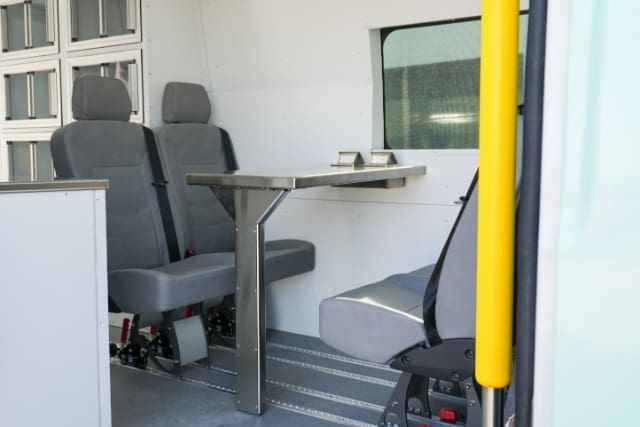
| Removable passenger seats | Offers flexibility to transport team members or clients during a crisis. You can reconfigure the space on the fly based on each situation. |
| Floor-to-ceiling medical-grade cabinets | Keeps supplies organized and out of the way, so your team can quickly access what they need in high-pressure situations. |
| Integrated desk and mobile office setup | Provides a quiet, functional workspace for documentation, care coordination, or private screenings without needing to leave the vehicle. |
| Fridge and integrated sink | Essential for storing medications like crisis intervention meds, or for basic health services like hydration, wound care, or hygiene needs. |
| Rear heat and air conditioning | Keeps the unit comfortable for both clients and staff in any season, whether you’re operating in Phoenix or Minneapolis. |
| Power supply with outlets, USB, and 12V | Lets your team charge phones, laptops, or medical devices while in the field, making the van a fully operational base. |
| Bright LED lighting | Creates a well-lit, professional environment for late-night or early-morning crisis response calls. |
| Clean, easy-to-sanitize interior | Helps protect both clients and staff by reducing the risk of contamination, especially when seeing multiple people in one shift. |
The Mobile Counseling Unit
| Feature | Why does it work for mobile crisis response teams? |
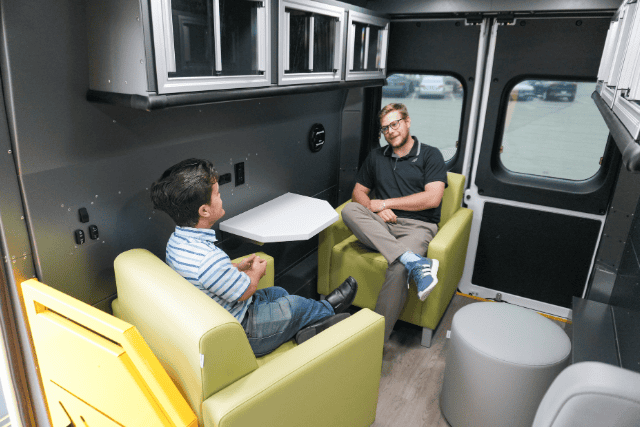
| Comfortable living room furniture | Creates a calming, familiar environment that helps clients open up during high-stress moments. Ideal for trauma-informed care. |
| Lockable storage cabinets | Keeps personal items, documentation, or sensitive materials secure when responding to multiple crises in a day. |
| Skylight | Adds natural light, which can ease anxiety and make the space feel more open and less clinical. |
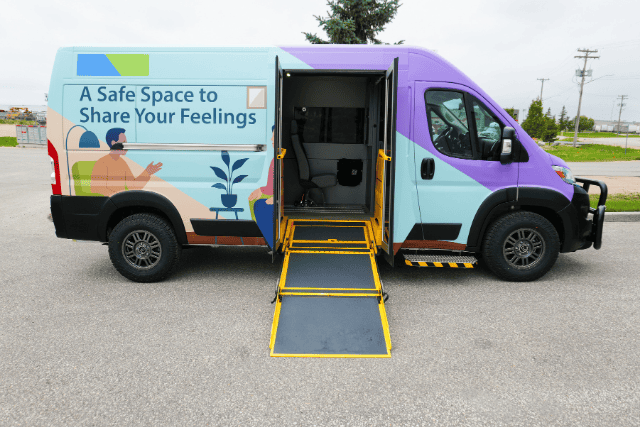
| Ramp for wheelchair access | Makes the unit accessible for clients of all abilities, removing barriers to care on-site. |
| Starlink Wi-Fi | Offers a reliable, secure internet connection for telehealth consults, accessing records, or coordinating with remote teams — even in rural areas. |
| Speakers | Helpful for calming background music, guided meditations, or communication needs during a session. |
| Rear heat and air conditioning | Keeps the space comfortable no matter the weather, which is key when parked for long periods during an intervention. |
Ready to support change with a mobile crisis response team?
When you started reading this article, you were likely asking: “What is a mobile crisis response team, and could it really make a difference in our community?” Maybe you’re tired of seeing people deal with long ER wait times, stretched first responders, or simply too many people falling through the cracks. You’re not alone, and there’s a better way.
Here’s what you’ve learned:
- The U.S. is in a mental health crisis, and the current response systems are overwhelmed
- People face real barriers when trying to get help
- A mobile crisis response team can meet people where they are and bring support directly to them
- The Mobile Outreach and Mobile Counseling Vans are two proven, purpose-built vehicles to do exactly that
At AVAN Mobility, we help organizations like yours bring healthcare to the people who need it. From city sidewalks to rural roads, our mobile units are trusted by health leaders across the country to provide calm, private, and professional care in crisis moments. We design every van with empathy, safety, and practicality in mind because we know that what you’re doing matters. If you’re ready to talk about the next steps, click below to connect with a mobility expert.
If you’re not ready to talk to a mobility expert just yet, no problem. Here are a few next reads that can help you move forward:
- How much does a Mobile Counseling Unit cost? Learn more about what you can expect to pay for a Mobile Counseling Unit.
- Mobile mental health clinics: Take the next step in learning more about mobile mental health.