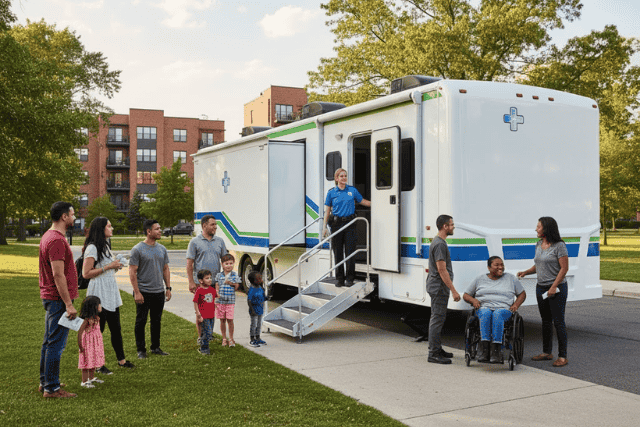
Almost 80% of rural America struggles with basic access to healthcare, which is a huge problem. Mobile medical trailers can help, but they also have their own issues.
You might feel stuck. You want to help your community, and you want a working mobile medical unit, but you’re worried about spending your budget on something that doesn’t quite meet your needs.
We hear this a lot.
Some issues with trailers are that:
- They can be hard to park
- Some don’t meet local health codes
- Others aren’t made for cold weather or bumpy roads
All of this can slow down your team and keep patients from getting care.
At AVAN Mobility, we’ve helped hundreds of health teams like yours and the Community Clinic of Southwest Missouri launch their first mobile unit. We’ve been doing this for over 10 years, and our goal is to help you bring care to the people facing serious barriers to it.
In this article, you’ll learn:
- The most common issues with mobile medical trailers
- Alternative options that could be a better fit for your program
Let’s start with the structural problems that cause the biggest headaches.
Top 5 most common issues with mobile medical trailers
Mobile medical trailers are a great way to reach people in hard-to-access areas. But they’re not perfect. In this section, you’ll learn about the five most common problems with mobile medical trailers. Knowing these can help you avoid costly mistakes and find a better fit for your team.
1. Mobile medical trailers are large
One of the biggest problems with mobile medical trailers is their size.
They’re hard to tow. They’re hard to park. And they can be dangerous on certain roads.
Here’s what makes size such a big issue:
- You need a heavy-duty truck to tow them (more on that later)
- Backing up or turning in small spaces is really tough
- Set-up takes longer, especially in tight or uneven spots
- Driving on muddy or gravel roads can lead to getting stuck
Imagine this: You’re trying to tow your mobile medical trailer down a muddy back road to a rural community. Halfway there, the trailer gets stuck. Your team can’t move forward. And an entire community of people goes without healthcare that day.
That’s the reality some programs face. Mobile medical trailers may look good on paper, but their size can stop you from getting care to the people who need it most.
A trailer might not be the best choice if your work takes you to remote or tight areas.
2. You need a heavy-duty truck to tow mobile medical trailers
Another major issue with mobile medical trailers is that you need a powerful truck just to move them.
These trailers are big and heavy. Most weigh between 10,000 to 20,000 pounds. That means your average pickup truck won’t cut it. You need a heavy-duty vehicle with a strong towing package, like a Ford F-350 or Ram 3500. And that comes with a cost.
Here’s why this is a problem:
- Heavy-duty trucks are an additional cost, often over $80,000
- They burn more fuel, which drives up operating costs
- Not everyone on your team can drive one, especially if you need a commercial driver’s license
- Maintenance and insurance are expensive
Let’s say your mobile clinic serves remote towns in Appalachia or across rural Texas. You’re driving long distances, up steep hills, or down winding backroads. If your truck breaks down, your whole clinic stops moving.
And it’s not just about the truck. You’ll also need a staff member who’s comfortable driving with a trailer attached, through traffic, rough roads, and tight turns.
Some teams don’t realize this upfront. They invest in a mobile medical trailer, only to find out later that they can’t move it safely or affordably.
If you’re thinking about buying a mobile health clinic, the cost and skill needed to tow it should be part of your decision.
Not every program is built for that kind of challenge.
3. Set-up takes a lot of time and effort
Another big problem with mobile medical trailers is how long it takes to set them up once you arrive.
When you get to a site, you can’t just open the doors and start seeing patients. There’s a long checklist you have to go through first.
Here’s what the setup usually involves:
- Leveling the trailer so it’s safe and stable
- Unhitching the trailer from the truck
- Connecting to power and water sources, if they’re even available
- Lowering stairs or ramps for patient access
- Turning on heating or cooling systems
Depending on the weather and the location, this can take 30 minutes to over an hour. At the end of the day, you have to pack it all up again.
Now imagine doing this in bad weather. In the pouring rain or freezing cold. Or worse, on soft ground that’s muddy or uneven, which is common in many parts of the U.S., especially during spring in the Midwest or Northeast.
Every extra minute spent setting up is a minute you’re not seeing patients. When you’re helping people in urgent need, like in low-income areas or disaster zones, delays like this can really hurt.
Time matters in healthcare. A long setup slows you down.
4. Mobile medical trailers need constant maintenance
Running a mobile clinic out of a trailer means you’re always keeping an eye on something that might break.
Mobile medical trailers are more than just a trailer. They’re part vehicle, part building, and part medical space. That means more things can go wrong, and they often do.
Here’s what needs regular attention:
- Tires, brakes, and hitches wear down from all the travel
- Generators need servicing to keep your power running
- Climate systems (A/C and heat) often struggle in rough conditions
- Hydraulic or manual leveling systems can jam or fail
- Roof seams and seals may leak in rain or snow
If your team is on the road in the U.S., especially in hot southern states or cold northern areas, those systems get pushed to the limit. And when something breaks, repairs aren’t always quick. You could wait days for a mobile mechanic or spend a lot hauling it to a service center.
Suppose your generator goes down in a trailer during a weekend health event. Now you’ve got no lights, no refrigeration for vaccines, and no way to see patients safely.
More moving parts = more downtime. That means less time is needed to help people who need care.
5. Mobile medical trailers can be expensive to buy and own
Mobile medical trailers cost a lot upfront and can be pricey to keep running.
When you look for a mobile medical trailer for sale, the price can surprise you. These trailers are built to hold medical equipment and handle travel, so the cost is higher than that of a regular trailer. Plus, prices in the mobile medical trailer market can vary a lot based on size, features, and customization.
Here’s what adds to the cost:
- Buying from trusted mobile medical trailer manufacturers who meet safety rules
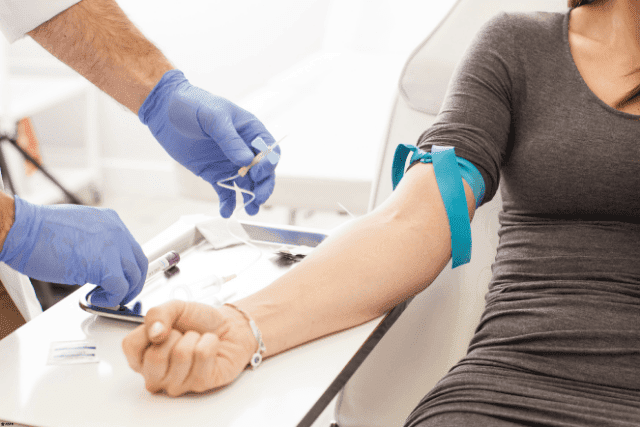
- Adding special equipment for exams or imaging, like in a mobile medical exam trailer or mobile medical imaging trailer
- Paying for regular maintenance and repairs to keep the trailer safe and reliable
- Insuring a trailer that travels on highways and visits different locations
For many organizations, the high cost means buying a mobile medical clinic trailer is a big decision. You want to make sure the trailer can serve your community well for years, but that means planning for costs beyond the sticker price.
Think about a rural clinic wanting to expand. They find a trailer that fits their needs, but need to budget for extra expenses like towing, maintenance, and insurance. These costs add up fast.
Understanding these expenses early helps avoid surprises later and keeps your mobile clinic running strong.
What’s an alternative option to mobile medical trailers?
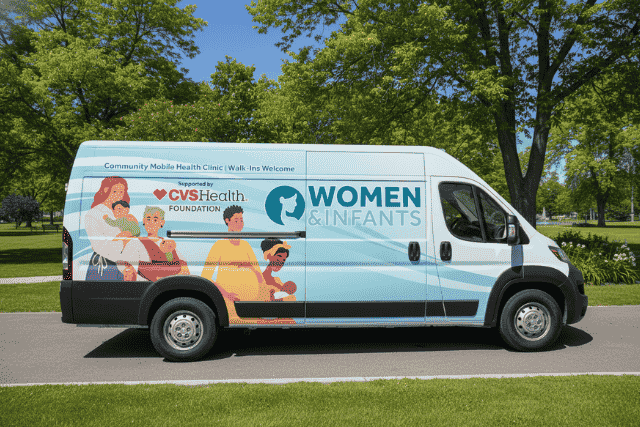
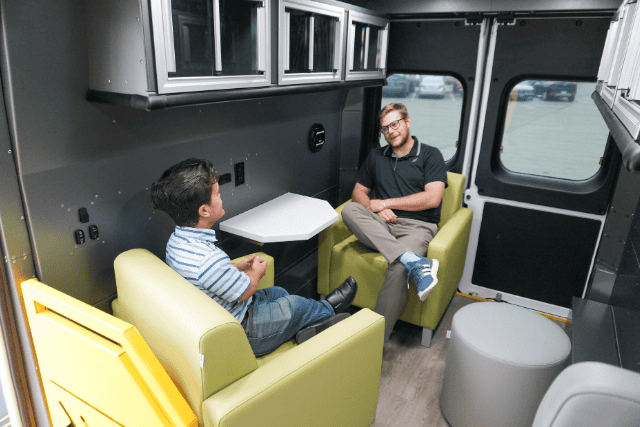
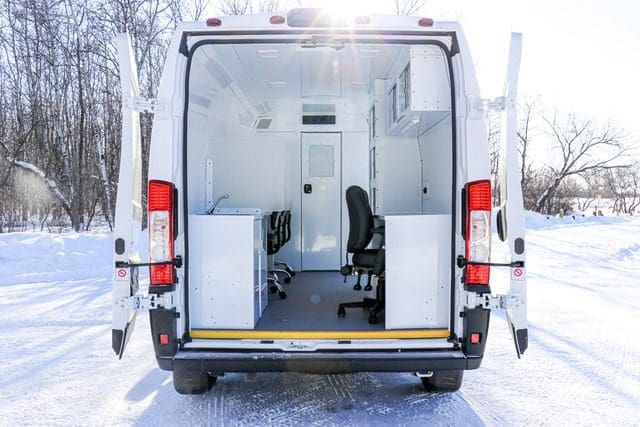
If you’re looking at mobile medical trailers, it helps to know about other options. One great choice is a mobile medical van. Depending on your needs, a van might work better for your team and your patients.
- Lower maintenance costs: As you’re aware, mobile medical trailers need a heavy-duty truck to tow them and require more upkeep overall. Mobile medical vans, like those made by mobile medical trailer manufacturers, use just one vehicle. This makes them cheaper and easier to maintain.
- Better fuel efficiency: Because trailers are bigger and heavier, towing them uses more gas. Mobile medical vans are lighter and use less fuel, which saves money, especially if you travel a lot.
- Easier to drive: Vans can handle tight city streets and rough rural roads better than trailers. Imagine trying to tow a mobile medical trailer down rough roads with sharp turns and steep inclines every mile. Vans give you more freedom to reach patients in tricky places.
- Smaller but still effective: If your focus isn’t on having multiple exam rooms or a large space, a mobile medical van is a good choice. It still offers an exam area and space for office work, but in a more compact design.
In the mobile medical trailer market, it’s smart to think about what fits your mission best. If you want something easier to manage and drive, a mobile medical van may be an option to consider.
Ready to solve your mobile medical trailer challenges?
You came here because you wanted to understand the problems with mobile medical trailers and how they might affect your healthcare mission.
Here’s what you learned:
- The five most common issues with mobile medical trailers and why they happen
- How these problems can impact your patients and team
- Alternative options, like mobile medical vans that might fit your needs better
At AVAN Mobility, we have spent years working closely with healthcare organizations like yours and Pacific Clinics to create smart, reliable transportation solutions. We know what works on the road and what helps you reach patients safely and on time. Our experience helps us understand how we can help you remove barriers to healthcare so you can provide the best services possible.
We are proud to lead the way in making healthcare mobile, accessible, and easier for everyone. If you have questions or want advice on your next step, click the button below to talk with a mobility expert who cares.
Not ready to talk yet? No worries. We have a few other helpful resources you can check out to learn more.
Start by checking out our article comparing mobile medical vans vs trailers. This could further help you decide which option is the right choice.
At this point, you might also be considering mobile medical RVs. To understand their differences, check out our article comparing vans and RVs.