Thinking about getting a mobile medical unit and wondering if an RV is the right choice? You’re not the only one. Many organizations look at mobile medical RVs because they seem roomy and easy to set up.
But here’s the catch: There are a few money pits of mobile medical RVs that most people don’t see coming. Repairs, fuel costs, and lengthy setup times can add up quickly.
Before you know it, your team is spending more time fixing problems than helping patients. That’s stressful, especially when your goal is to reach more people and make care easier to access.
At AVAN Mobility, we’ve spent over 10 years helping organizations like yours and CalOptima, Pacific Clinics, and Siskiyou County bring healthcare to people who need it. We’ve built over 150 mobile medical units across the U.S., each one designed to reduce barriers to care and help programs endure in the long term. While we’re confident in what we do, this article isn’t about us; it’s about helping you make the best choice for your program before investing in a mobile medical RV.
Here’s what you’ll learn in this article:
- The top five money pits of mobile medical RVs: Maintenance, fuel and mileage, vehicle size, setup and teardown time, and downtime from repairs.
- Important things to think about before choosing the right vehicle for your healthcare program.
What are the five unexpected money pits of mobile medical RVs?
You might think mobile medical RVs are a quick, cost-effective way to bring care to your community. But once the keys are in hand, the real expenses start to show up. The money pits of mobile medical RVs often catch organizations by surprise and can turn a well-meaning investment into a budget strain. Let’s take a closer look at the five biggest areas where costs tend to pile up and why they matter for your program’s long-term success.
1. Maintenance
At first glance, a mobile medical RV can look like the perfect setup. It’s big, impressive, and seems ready to hit the road. But once you start using it every day, maintenance costs start to pile up fast. This is one of the biggest money pits of mobile medical RVs, and it can quietly drain your budget before you even notice.
Most RVs are built for family road trips or weekend camping, not daily healthcare work. When your team drives from town to town, keeps the engine running during patient visits, and sets up in different weather conditions, things wear out quickly. Tires, brakes, air conditioners, and generators all need more attention than you might expect.
Now think about everything you’ve added to turn that RV into a clinic, including exam tables, medical fridges, extra wiring, and air filtration. Every new system means one more thing that can fail. When something does, you can’t always take it to a regular mechanic. Specialized service centers charge more and can take longer to schedule. That downtime means your team misses days of seeing patients, which affects your budget and the people you serve.
Common hidden maintenance costs:
- Extra wear and tear: Daily use takes a toll on engines and parts fast.
- Generator burnout: Keeping the lights and equipment running all day strains the system.
- Leaks and water damage: Big roof areas make them more likely to spring leaks.
- Limited repair shops: Medical upgrades mean fewer places can fix your RV.
If your mobile clinic keeps ending up in the shop, it’s not just losing money. It’s losing time, trust, and impact. Maintenance might seem small at first, but in a mobile health program, it can turn into a major roadblock for care.
2. Fuel and mileage
Fuel costs might seem like a small detail at first, but they quickly become one of the biggest money pits of mobile medical RVs. These vehicles are big, heavy, and far from fuel-efficient. Most get around 7 miles per gallon, which means every trip adds up faster than you think.
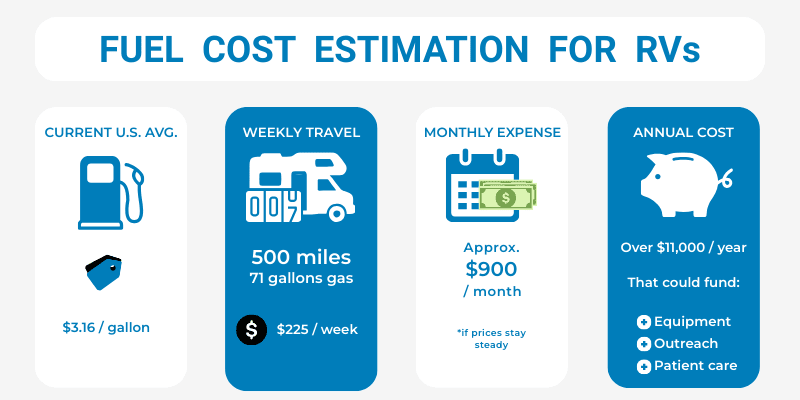
And it’s not just the gas that hurts your wallet. The more you drive, the faster parts wear out. RVs aren’t built for daily healthcare routes; they’re built for vacation miles. Each trip adds extra strain on the brakes, tires, and engine. Combine that with idling for hours during clinics or waiting on-site, and your fuel costs rise even higher.
Where fuel and mileage costs sneak up:
- Heavy load: Medical gear, staff, and supplies make the RV burn more fuel.
- Lots of idling: Running the engine for heating or cooling during visits eats gallons fast.
- Rural routes: Long drives between towns mean more miles and higher costs.
- Fuel spikes: Even small price jumps add up over time.
Before long, what seemed like a simple fuel budget becomes a constant expense that eats into your funding. Every extra trip chips away at your budget, and every long drive shortens the life of your vehicle. Over time, it’s easy for fuel and mileage costs to slow down your mission instead of moving it forward.
3. Vehicle size
At first glance, the size of a mobile medical RV seems like a major plus. There’s room for staff, patients, and all the equipment you need. But that large size can quickly become one of the most unexpected money pits of mobile medical RVs. Bigger vehicles bring more challenges than most teams expect once the program is up and running.
One of the biggest issues is access. Many communities you want to serve simply aren’t built for something that large. Downtown areas, older neighborhoods, or small rural roads can be tough to reach. You might find yourself circling a parking lot, stuck under a low bridge, or needing special permits just to park for the day. In places like older city centers in the Northeast or small-town main streets in the Midwest, a full-sized RV can be more of a showpiece than a tool for care.
Then there’s the day-to-day hassle of managing it. Larger vehicles can require extra staff to guide parking or manage patient flow because of their height, length, and limited maneuverability. They can also be more sensitive to wind and weather, which makes driving stressful and sometimes unsafe. Programs often underestimate how much training or planning it takes just to move from one site to another safely.
How size becomes a hidden cost:
- Harder to deploy: Fewer locations can safely accommodate the vehicle.
- Time drain: Setup and breakdown take longer at each stop.
- More staff needed: Large vehicles often need a second person to navigate or assist.
- Higher risk of damage: Tight turns and low clearances increase the chance of costly scrapes or roof repairs.
While a large RV may look impressive on day one, it can limit your flexibility and slow your schedule down the road. A mobile medical program succeeds when it’s nimble and accessible, not when it spends half its time figuring out where to fit.
4. Setup and teardown time
When people picture a mobile medical RV, they often imagine it rolling in, opening the doors, and getting right to work. In reality, setup and teardown take time—sometimes a lot of time. This is one of the most overlooked money pits of mobile medical RVs, and it can quietly eat away at your program’s schedule, budget, and staff energy.
Every location change comes with a checklist: parking, leveling the vehicle, extending awnings, setting up ramps, powering up medical equipment, and getting HVAC systems running. Depending on your setup, this can easily take anywhere from 30 minutes to over an hour before the first patient walks in. Then you have to do it all again when it’s time to leave. For programs with multiple stops per week, that’s hours of unpaid downtime.
And downtime costs more than just fuel. The longer your team spends setting up and tearing down, the fewer patients they can see. Over time, that affects both your impact and your bottom line. Staff fatigue also becomes real—repeated heavy lifting, adjusting equipment, and troubleshooting systems add strain that leads to burnout or even injuries.
Where setup and teardown time add hidden costs:
- Lost service hours: Every extra hour spent setting up is an hour not serving patients.
- Staff fatigue: Manual setup tasks wear your team down fast.
- Equipment strain: Repeatedly powering systems on and off increases the chance of failure.
- Schedule delays: Longer prep times can throw off appointments and outreach plans.
Mobile healthcare works best when it’s efficient. But when a vehicle takes too long to get ready, your program loses its biggest advantage: Speed and flexibility. What should feel like a mobile clinic starts feeling like a moving puzzle, and those small delays can add up to a big drain on your time, energy, and budget.
5. Downtime from repairs
Few things are more frustrating than having your mobile clinic parked when it should be serving patients. Yet downtime from repairs is one of the most expensive and disruptive money pits of mobile medical RVs. When your vehicle breaks down, you’re not only paying for parts and labor, you’re losing valuable time, momentum, and trust in your community.
Unlike smaller, purpose-built medical vehicles, RVs rely on consumer-grade parts that weren’t made for heavy, daily use. When something goes wrong, it’s rarely a quick fix. Waiting on specialty parts or finding a repair shop large enough to handle your vehicle can take weeks. Meanwhile, scheduled visits get canceled, and your staff still needs to be paid. Downtime for large vehicles can cost organizations over $450 to $760 per day in lost productivity.
Downtime also creates ripple effects. When your clinic misses appointments, patients lose trust, and communities start to view the service as unreliable. That reputation can take longer to repair than the vehicle itself. Even small breakdowns like air conditioning failure in hot climates or power system issues can sideline operations until the right part arrives.
Hidden ways downtime adds up:
- Lost outreach days: Every day in the shop is a day patients go without care.
- Extra transport costs: You might need to rent or borrow another unit to fill gaps.
- Staff downtime: Workers still get paid, even when the clinic isn’t running.
- Reduced reliability: Missed visits can hurt relationships with partners and funders.
Repairs are a part of any vehicle’s life, but with RV-style builds, they hit harder and more often. When your clinic is out of service, your mission pauses, and in healthcare, that lost time can mean more than just lost dollars. It can mean lost opportunities to reach the people who count on you most.
What should you think about when choosing the right vehicle for your mobile healthcare program?
Now that you know the biggest money pits of mobile medical RVs, it’s time to take a step back and think about what kind of vehicle truly fits your program. Choosing the right one isn’t just about how big it looks or how much equipment it can hold. It’s about finding something that helps your team reach more people, saves time, and keeps your budget focused on care—not repairs.
The truth is, bigger isn’t always better. A large mobile medical RV might look impressive, but it can come with more challenges than you expect. Between high fuel costs, tight parking, and frequent maintenance, an RV can sometimes feel like more of a burden than a solution.
Before you make the investment, it’s worth asking yourself some honest questions:
- Where will we be driving most? If your routes take you through small towns, city streets, or rural areas with narrow roads, a smaller vehicle may make your life easier.
- How often will the unit move? If your team sets up daily or travels often, the time and cost of operating a large RV will add up fast.
- What services do we actually need to deliver? Not every program needs multiple rooms or full hospital-style setups. Sometimes, a smaller van with one exam bed is more efficient and flexible.
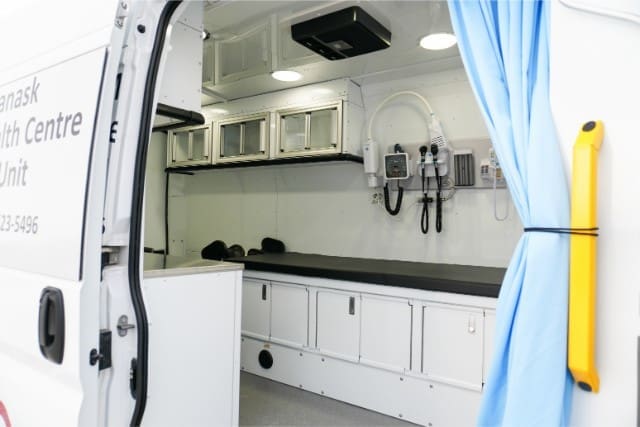
This is where a mobile medical van can make sense. Vans are easier to drive, park, and maintain. They can still be fully equipped for screenings, counseling, or basic exams, but without the heavy operating costs of a full-size RV. Because they’re smaller, they often use less fuel, fit into tighter spaces, and can reach areas that big RVs can’t. If you serve both urban and rural communities, that flexibility can be a game-changer.
How can a smaller mobile medical unit make a bigger impact?
There are a few ways in which a smaller mobile medical unit can make a larger impact:
- Less downtime: Easier maintenance means your clinic stays on the road longer.
- Lower costs: Smaller vehicles typically use less fuel and have cheaper parts.
- Simpler setup: You can arrive, park, and start seeing patients faster.
- More flexibility: Switch between sites or events without worrying about space or height limits.
- Less stress: Your drivers and staff won’t need extra training or special licenses.
That said, size isn’t the only factor. Think about your community’s needs, the type of care you provide, and the people you serve. A larger RV might make sense if you need multiple exam rooms or on-site imaging. But if your goal is outreach, screenings, or connecting patients to local care, a smaller van can stretch your budget further while reaching more people.
What matters most is finding a vehicle that supports your mission, not one that makes it harder to achieve.
Ask yourself: Does this design help us serve people faster, more safely, and with less hassle? If the answer’s yes, you’re on the right track.
At the end of the day, the best vehicle isn’t always the biggest one; it’s the one that helps your team do what matters most: bring healthcare to those who need it without getting stuck in the process.
Need help choosing the right mobile medical unit?
You came here because you’re thinking about a mobile clinic and want to avoid costly surprises. After reading, you now know the money pits of mobile medical RVs and how they impact long-term success.
Here’s what you learned:
- The top 5 hidden costs that drain healthcare budgets.
- What to consider when choosing between large RVs and smaller medical vans.
- How the right-sized vehicle keeps your mission moving forward.
At AVAN Mobility, we believe that the right vehicle should work for you, not against you. For over a decade, our team has partnered with hospitals, nonprofits, and health departments across the U.S. to design vehicles that fit real-world needs. We focus on making mobile healthcare practical, reliable, and sustainable so you can focus on what matters most: People. If you have questions or want to explore your options, click the button below to talk to a mobility expert today.
If you’re not ready to talk yet, here are a few helpful next reads to guide your next step:
- Pros and cons of mobile medical vans vs. RV clinics: See a side-by-side comparison to help you decide which fits your program best.
- How Much does a mobile medical unit cost in the U.S.? Understand what drives pricing before setting your budget.
- How to choose a mobile medical van: what you need to know: Learn how to pick the right van design to match your healthcare mission.