Here at AVAN Mobility, we don’t believe that great care should be a privilege. We see it as a fundamental right. Every day, we partner with innovative organizations across North America that share our vision: to remove the obstacles that stand between vulnerable populations and the essential health and transportation they deserve.
This is the story of one such leader, Women & Infants Hospital, a place dedicated to excellence in maternity care. Newsweek rated Women & Infants as one of the best healthcare centers in the U.S. for its maternity services. The hospital recognized a vital gap in care that needed to be filled. They saw structural barriers limiting access for new mothers who had just delivered at the hospital, but who struggled to come back for necessary postpartum care.
We were honored to partner with them to manufacture their new Community Mobile Health Clinic. It’s a dedicated space for health, dignity, and connection, ensuring that the first few months of motherhood, known as the ‘fourth trimester,’ are supported and safe. This mobile unit is a powerful example of how innovative vehicles are truly enablers of health, freedom, and connection.
The critical challenge of the fourth trimester
The first six weeks after a baby is often called the “fourth trimester.” While everyone focuses on the new baby, this is a seriously important time for the mother’s health, too. Think of it like this: your body just ran a marathon, and now it needs serious, immediate attention, but you’re also juggling the biggest life change possible.
Unfortunately, this crucial period became a time of high risk for many patients at Women & Infants Hospital.
Danielle Simmons, a family nurse practitioner at Women & Infants who now oversees the mobile clinic, was one of the key voices pointing out the problem. She and the staff noticed significant gaps in patient care during this time.
“We noticed definite gaps in care for our postpartum patients who had delivered at Women & Infants,” Simmons said. “There was a period of time, we call it the fourth trimester, which is really the first six weeks postpartum, when patients were getting discharged from the hospital but were not following up with their providers until six weeks later at the post-partum visit. There were a lot of healthcare changes that were occurring, blood pressure issues, diabetes issues, and wound problems that were arising.”
This lapse in care can be dangerous. When women can’t follow up with their doctors, issues like dangerously high blood pressure or diabetes complications can spiral out of control. These are the serious short or long-term health problems that result from being pregnant and giving birth, known as maternal morbidity.
What’s the maternal health risk?
The National Institutes of Health (NIH) explains that maternal morbidity includes a range of serious issues: from heart disease and high blood pressure to infections and depression. These are not minor problems; they are life-altering conditions that demand immediate and ongoing medical supervision.
So, why were these new mothers struggling to get back to the hospital for care?
The barriers were all about basic needs:
- No car or money for a ride service.
- No one to watch their newborns (making leaving home nearly impossible).
- Other obstacles that simply made leaving the house too difficult.
For a new mother facing health complications, the simple act of trying to coordinate transportation and childcare just to get a blood pressure check becomes an overwhelming, stressful barrier. When we remove that barrier, we restore dignity and peace of mind.
A vision of care delivered right to the doorstep

The staff at Women & Infants Hospital knew they had to do better for their moms. They realized that the traditional model, where patients must come to the hospital, was the problem, not the patients themselves. They had to flip the script.
Danielle Simmons sparked the idea for the solution. She remembered a past time when the hospital used an RV to go out into the community, and she saw how powerful that model could be again.
“I told him I remembered being a student nurse here and seeing an RV that used to go out into the communities and provide visits. And I said, ‘that would be a great opportunity to catch these patients that might have transportation difficulties or mobility issues and provide care to the homes or in the area.’”
This simple realization was the beginning of something life-changing. It was a commitment to proactive care.
Dr. Methodius Tuuli, the hospital’s Chief of Obstetrics and Gynecology, quickly embraced this innovative approach. This meant eliminating the logistical obstacles that prevent essential check-ups. They knew this mobile unit would immediately remove stress and worry from the lives of their patients.
Dr. Tuuli perfectly captured the impact the mobile clinic would have when the project launched:
“The van allows us to accelerate progress towards improved perinatal health in Rhode Island with the simple act of removing transportation as a barrier to receiving postpartum care.”
Funding the innovative solution
Through a generous $1 million grant from the CVS Foundation, the vision became a reality. This funding was an important acknowledgment that this kind of proactive, compassionate approach is not just a benefit; it is an essential strategy for improving public health.
This shift in service delivery empowers mothers. It recognizes their challenges and provides them with control over their health, rather than requiring them to overcome impossible obstacles. This is what true inclusion looks like: designing systems that work for everyone, especially those facing the toughest circumstances.
Dignity delivered: How the mobile clinic works

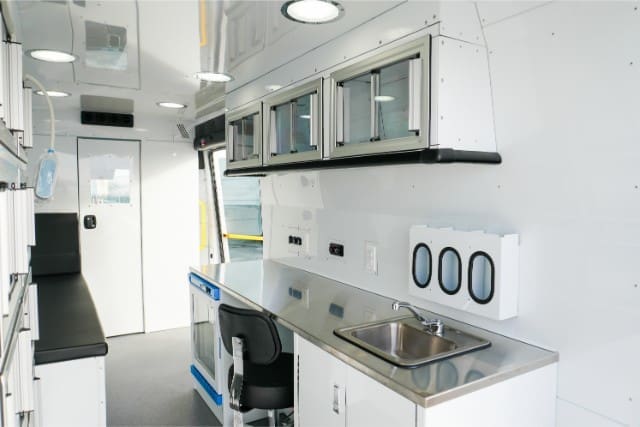
When we look at the mobile medical unit we manufactured for Women & Infants Hospital, we don’t see metal and motors. We see a comfortable, safe, and private space that delivers dignity. Here, a new mother can finally sit down, be seen, and receive support without the stress of logistics weighing her down.
The clinic is staffed by Danielle Simmons, the nurse practitioner, and a Certified Community Health Worker (CHW). This team ensures the care is truly holistic and connected to the community.
The services provided are comprehensive and focused on identifying the serious issues that often arise in the first six weeks.
Critical services offered on the mobile clinic:
- Daily blood-pressure monitoring: This is huge, as high blood pressure is one of the most serious post-delivery risks. They provide mothers with blood pressure cuffs to use at home and log readings into the hospital’s system.
- Wound and diabetes checks: Addressing physical healing and monitoring chronic conditions.
- Mental health support: Offering vital counseling and checks for depression and anxiety.
- Community-based follow-up: Ensuring patients are connected to other critical services they need in their own neighborhoods.
The blood pressure monitoring system is a great example of innovation in action. If the team sees a suspicious reading, too high or too low, they can immediately check in with the mom, talk to her, and adjust her medication if needed. This immediate, proactive intervention can be the difference between a small issue and a life-threatening emergency.
Going beyond the medical chart
The care goes far beyond just the medical chart. Danielle Simmons highlighted the importance of looking at the whole person and their life circumstances. This is where the emotional impact of the mobile unit truly shines, focusing on the human side of postpartum care.
“We also recognize that there are other things within the body that can be affecting other areas. So you’re not sleeping well. How is that affecting your blood pressure? You’re getting different foods from a variety of different people bringing food over, but if it’s very high in sodium, that’s not going or help your blood pressure. Or if food is high in sugar, that’s not going to help your diabetes. Also, are you getting enough support at home? That’s a huge factor.”
This quote shows the fundamental difference between traditional medical check-ups and the compassionate care delivered by a mobile unit. Instead of just treating a symptom, the staff is empowered to ask: How are you doing, really? They are looking at social drivers of health: sleep, diet, stress, and community support, which are often impossible to address in a quick hospital visit. The mobile unit provides the time and intimacy needed for this deeper connection.
The powerful push for equity and better outcomes
The presence of the Community Mobile Health Clinic in certain neighborhoods is not an accident; it is a direct response to a need for health equity. When we discuss removing barriers, we refer to addressing the systemic issues that lead to poorer health outcomes for certain groups.
The data shows this reality clearly. Statistics generated by the Rhode Island Department of Health on “severe maternal morbidity,” the health outcomes that can have significant consequences in the short or long term, reveal deeply concerning disparities.
| Population group | Severe maternal morbidity rate (per 10,000 deliveries, 2019-2023) |
| Black women | 115.8 |
| Hispanic women | 114.2 |
| White women | 69.8 |
The numbers clearly show that severe maternal health complications affect women of color far more than white women. Furthermore, geographically, the core cities of Providence, Pawtucket, Central Falls, and Woonsocket showed a rate of 105.6 per 10,000 deliveries, compared to 76.8 for the rest of the state.
Addressing systemic health inequities
These figures are a call to action. They show that relying on traditional clinic visits allows existing inequities, related to income, neighborhood, and access to resources, to continue to impact lives. The mobile unit is a tool designed to break that cycle. It works by targeting care directly to the areas where the risk is highest.
Experts in the health policy field have been quick to praise Women & Infants for this impactful move. They understand that this innovative delivery system helps level the playing field.
Elizabeth Burke Bryant, a Professor of the Practice of Health Services, Policy and Practice at Brown University School of Public Health’s Hassenfeld Child Health Innovation Institute, praised the clinic’s strategy:
“The Community Mobile Health Clinic brings timely postpartum screenings, hypertension checks, and mental health support directly to patients where they are, and helps to remove transportation as a barrier to care.”
Dr. Elizabeth B. Lange, a pediatrician and past president of the Rhode Island Medical Society, spoke to the broader success of this model across the country:
“Nationwide, data shows that mobile vans bringing healthcare directly to neighborhoods improve health access, outcomes, and equity. Rhode Island is quite lucky to have two such mobile healthcare services: the mental health mobile crisis unit and the Women and Infants Community Health Van.”
This mobile unit is a champion of progress. It means a mother doesn’t have to choose between finding a babysitter and having her blood pressure checked. It means a mother can receive life-saving care without the shame or stress of admitting she can’t afford a taxi. It’s a tool for empowerment, ensuring that every mother feels seen and valued during her most vulnerable time.
Why is community health so important?
Michaela Carroll, Health Policy Associate at Rhode Island KIDS COUNT, emphasized the role of the Community Health Worker (CHW) in making this approach successful. They don’t just administer medicine, they build bridges to critical community services.
“It is important that a Community Health Worker (CHW) is a part of the team, since CHWs are an integral part of community care. It is our hope that this new resource will help address barriers to contraceptive counseling and services, management of gestational hypertension, and breastfeeding support and improve outcomes for women and babies.”
The vehicle, staff, setup, and targeted services all focus on one central goal: improving life-changing outcomes for mothers and babies. It does this by making care as easy and respectful as possible.
The impact of this approach is felt even at the state level. Dr. Michael Fine, a family physician and former head of the state Health Department, praised the vision of this kind of proactive care:
“I’ve heard only a little about it, but it’s part of my dream of a health care system where we include every single person, and reach out to those with specific risks,” said Dr. Michael Fine, family physician, writer, and head of the state Health Department from 2011 to 2015. “Imagine them going out to every single new mom, or having a nurse visit every single new mom once a day for two weeks and then twice a week for three to six months.”
This is the kind of forward-thinking vision that Women & Infants Hospital is already turning into a reality.
Saving lives, one neighborhood at a time

At the heart of every vehicle we manufacture is the fundamental belief that we don’t just build vans, we save lives. The case of the Women & Infants Hospital Community Mobile Health Clinic clearly shows this in action. They took an urgent, potentially life-threatening problem, the lack of accessible postpartum care, and solved it with innovation and compassion.
The elimination of transportation and childcare as obstacles meant Women & Infants empowered mothers to prioritize their own health alongside their newborns. This mobile clinic serves as a safe haven and a powerful symbol of a healthcare system reaching out to its community, demonstrating that their well-being matters deeply.
This mobile unit is an enabler of health, freedom, and connection. It delivers expert medical care right to the people who need it. It ensures critical checks on blood pressure, diabetes, and mental health are never missed. The positive outcome is not just a lower incidence of severe maternal morbidity; it is a mother who feels supported, respected, and empowered during the beautiful, challenging ‘fourth trimester.’
At AVAN Mobility, we’re proud to champion organizations like Women & Infants Hospital, which are leading the way in providing innovative vehicles that are accessible to all. Their commitment demonstrates that when we remove barriers, we restore people’s sense of dignity and enable them to lead healthier, more fulfilling lives. This is the kind of human-centered progress that drives us every single day. If you have any questions, don’t hesitate to click the button below.