Did you know that over 2 million women in the U.S. live in “maternity care deserts” where there are no birthing hospitals or OBGYN providers? This gap in care creates a lot of stress for moms and families. You might feel worried or even scared for the women in your area who can’t get to a doctor. It’s hard to watch people struggle just to get a basic checkup.
When mothers can’t get care, it puts their health and their baby’s health at risk. You want to help, but the distance and lack of clinics stand in your way. There is a better way to bring safety and smiles back to these families.
At AVAN Mobility, we’ve been helping organizations like yours for over 10 years. We’ve built more than 150 mobile medical units to help save lives. We’ve worked with organizations like Women & Infants Hospital to reach people who struggle to access healthcare. We hold Ford Pro and Stellantis QPro certifications, so we know how to build things right. We know we aren’t the only ones who make these vehicles, but we want to help you make the best choice for your mission.
In this article, you will learn about the five features of mobile OBGYN units.
- OBGYN access gaps
- Continuous care
- Private and dignified design
- Maternal outcomes
- Funding and policy alignment
What are the five features of mobile OBGYN?
Providing great care means looking at the big picture of how mothers live and travel. The five features of mobile OBGYN in this section focus on the real-world hurdles your patients face and how you can fix them through going mobile with OBGYN care.
1. Mobile OBGYN helps to close access gaps
Imagine a young woman named Wendy who lives in a small town in North Dakota. She just found out she’s pregnant. She’s excited, but then she realizes the nearest doctor who can help her is over four hours away.
Sarah doesn’t have a reliable car, and taking a whole day off work for a checkup is almost impossible. This is the reality for millions of people. When you bring your OBGYN services to them, you’re giving them a chance at a healthy life. You’re meeting Sarah right where she lives, removing the stress of travel and the fear of missing out on care.
Understanding the map of care in the U.S.
The problem of maternity care deserts is a growing crisis across the country. A “desert” is a county where there are no birthing hospitals or doctors who specialize in OBGYN care. According to recent data, over 35% of U.S. counties are considered maternity care deserts. This means families have to travel long distances for even the simplest appointments.
- North Dakota: About 73.6% of counties in this state are maternity care deserts.
- South Dakota: Over 57% of counties face these same gaps.
- Mississippi: This state has around 51.9% of counties lacking any local care.
- Missouri: Around 51.6% of the counties here don’t have enough providers to meet the needs of their communities.
Living in these areas is a huge inconvenience when it comes to healthcare. Research shows that women in these counties have a 13% higher risk of having a baby born too early. When you use mobile units to reach these spots, you’re filling a hole in the healthcare system. You’re making sure that no matter where someone lives, they have the dignity of high-quality care.
Mobile OBGYN units enable you to reach those who need help
Mobile medical units bridge the gap for people who might feel forgotten by the big city hospitals. For example, in rural parts of California or the vast plains of Nebraska, a mobile clinic is a beacon of hope. It tells the community that their health matters.
- Lowering travel time: The average travel distance in a care desert is about 28 miles, compared to just 8 miles in cities.
- Building trust: Many people in remote areas feel more comfortable visiting a local mobile unit than a giant, cold hospital far away.
- Early detection: You can find health issues like high blood pressure early, which saves lives.
2. Mobile OBGYN enables continuous care

When a woman finds out she’s expecting, she needs more than just one visit. She needs a partner who’ll be there from the first trimester all the way to her first few weeks at home with the baby. This is what we call continuous care. It’s like a long conversation that keeps her and her baby safe. Without it, things can get missed. If she has to find a new doctor every month or drive hours to a clinic, she might skip a visit. That’s when small health issues can turn into big problems.
With a mobile OBGYN unit, you’re able to stay in her life through every stage. You aren’t just a face she sees once; you’re a familiar friend who pulls up to her neighborhood. This creates a bond of trust. When a patient trusts you, she’s more likely to share her worries. You can track her blood pressure and watch the baby grow over time. This kind of steady support is a game-changer for maternal health.
Why does staying connected matter for moms?
Research shows that consistent prenatal care leads to much better results for both mom and baby. If a mom misses her regular checkups, the risk of her baby being born with a low birth weight is three times higher. That’s a scary thought. When you bring your mobile unit back to the same area every month, you’re making sure women don’t fall through the cracks.
- Managing chronic issues: You can help a mom manage things like diabetes or high blood pressure throughout her whole pregnancy.
- Mental health support: Frequent visits allow you to check in on how she’s feeling emotionally, which is just as important as her physical health.
- Postpartum visits: Care shouldn’t stop after the baby is born. Your mobile unit can check on her during those first few weeks at home when she’s most tired.
- Education and prep: You have time to teach her about breastfeeding and what to expect during labor because she sees you regularly.
Having a mobile clinic means there’s no “out of sight, out of mind.” You’re right there in her community. This kind of care gives a woman the power to feel in control of her body and her future. It’s a beautiful way to show her that she isn’t alone on this journey. As you offer a steady hand, you’re helping her bring a healthy, happy baby into the world.
3. Privacy and dignity
Think about a carpenter for a second. If they want to build a house, they use a power saw, not a tiny hatchet. Using the right tool makes the work better and faster. It’s the same for you. When you have a mobile medical space made just for women’s health, it changes how you work. It also changes how your patients feel. Walking into a cold, cramped vehicle doesn’t feel good. But walking into a clean, quiet, and private mobile clinic feels like stepping into a real doctor’s office. It tells your patient that she is worth it.
The features of mobile OBGYN units focus on making women feel safe and respected. This is so important when she’s getting an exam. Privacy isn’t just a rule; it’s a way to show compassion. When a unit is designed right, it creates a sanctuary. It helps her relax, so you can do your best work.
What tools inside help you provide better care?
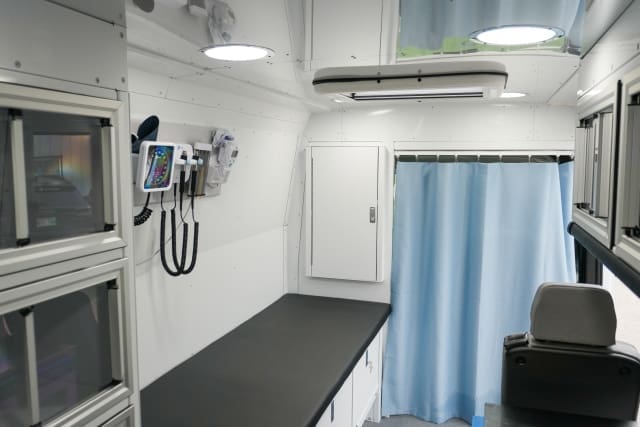
A mobile medical unit is a workspace that’s built for the specific needs of OBGYN care. You need a place for everything so you can focus on the person in front of you. Having the right layout means you aren’t bumping into anything while you’re trying to help a patient.
- Professional exam beds: These are built for comfort and give you the room you need to do exams properly.
- Medical-grade fridges: You need these to keep medicines and vaccines at the perfect temperature so they stay safe.
- Clean sinks and water: Having a real sink allows you to keep things clean and follow medical rules easily.
- Smart storage: Plenty of cabinetry keeps your tools tucked away but easy to reach, so the room stays tidy and calm.
- Specialized equipment: You can have portable ultrasound machines, Welch-Allyn tools, and other equipment right there in the van.
When you have the right mobile medical equipment, you’re empowered to give the best care possible. You don’t have to apologize for a lack of space or gear. Instead, you can welcome your patients into a space that feels professional and warm. This level of quality helps remove the stigma of mobile care. It shows the community that they’re getting top-tier treatment, no matter where the van is parked.
4. Improved maternal outcomes

Every parent wants a healthy start for their new baby. But in the U.S., we’re facing a big challenge. Our country has the highest maternal mortality rate among wealthy nations. This is a heavy heart-to-heart talk, but it’s important. Many of these deaths are preventable. When moms can’t get to a doctor, small things like high blood pressure can become life-threatening. When you use a mobile clinic, you’re changing the story. You’re giving moms the power to have a safer pregnancy and a healthier future.
When a woman has access to healthcare, she’s getting a shield of protection. Early visits mean you can catch problems before they grow. It’s about more than just medicine; it’s about peace of mind.
How does regular care change the numbers?
The data shows a clear picture of how much regular care matters. When moms miss out on prenatal visits, the risks go up fast. Babies born to moms without care are five times more likely to die than those who get regular checkups. That’s a statistic that stays with you. It shows why your work is so vital.
- Preventing early births: Regular care helps lower the chance of preterm births, which gives babies a stronger start.
- Managing blood pressure: Doctors can spot preeclampsia early, which is a leading cause of trouble for moms.
- Stopping the gaps: States with more care providers and fewer “care deserts” see much better outcomes for families.
- Lowering infant mortality: Healthy moms are more likely to have healthy babies who grow up strong.
Better outcomes through connection
Maternal health is about how a mom feels. When she knows her mobile OBGYN doctors are coming to her neighborhood, she feels a sense of support. This reduces stress, which is great for her and the baby. In places like rural Georgia or Mississippi, where hospitals are closing, your mobile unit is a lifeline.
| Maternal health fact | Impact of regular care |
| Preventable Deaths | Over 80% can be stopped with timely care |
| Low Birth Weight | 3x more likely without prenatal visits |
| Chronic Issues | Early detection allows for safe management |
When you bring maternal healthcare to the community, you’re removing the “what ifs.” You’re making sure that every mom, regardless of where she lives, has the same chance at a happy ending. It’s about dignity and the right to a healthy life. When you improve these outcomes, you aren’t just helping one person. You’re strengthening an entire family and building a better community for everyone.
5. Funding and policy
If you’re a healthcare organization interested in a mobile OBGYN unit, you’re likely asking, “How do we pay for this?” or “Will the government support our mission?” The great news is that the wind is at your back. Right now, there’s a huge shift in U.S. policy toward maternal health. Leaders in Washington and in state capitals are realizing that they can’t fix maternal health without reaching people where they live. As a result, new grants and programs are emerging specifically to support organizations like yours in establishing these lifelines.
When you align your program with these policies, you’re joining a national movement to save lives. It’s about showing that your work matches the goals of big health agencies. This makes it much easier to get the money you need to keep your doors and your van doors open.
What are the actual numbers for funding?
It’s one thing to hear about support, but it’s another to see the proof. In 2024 and 2025, we’ve seen some massive investments in mobile care. For example, the Health Resources and Services Administration (HRSA) has been pushing millions into maternal health innovation programs.
- The TMaH model: CMS (Centers for Medicare & Medicaid Services) launched the Transforming Maternal Health (TMaH) Model, which gives states up to $17 million each to improve care for moms on Medicaid.
- Direct relief grants: In late 2024, organizations like the UF Mobile Outreach Clinic won $1.2 million specifically to put a new maternal health mobile unit on the road.
- Rural MOMS Act: This policy helps fund projects that increase access to OBGYN care in rural areas, specifically targeting the care deserts we talked about earlier.
| Funding source | Focus area | Impact example |
| HRSA grants | Workforce and access | $9 million for state maternal health experts |
| Direct relief | Health equity | $8 million in total grants for mobile units |
| CMS TMaH model | Whole-person care | 10-year support for state Medicaid agencies |
How does this help your organization?
When you choose a mobile unit, you’re checking all the boxes that grant-makers love. You’re solving the “access” problem, you’re helping with “equity,” and you’re focusing on “outcomes.”
- Medicaid alignment: Many states are now making it easier to get paid for services done on a mobile unit.
- Showing proof: Because mobile units are so good at reaching underserved groups, it’s much easier for you to prove to donors that their money is making a real difference.
- Bipartisan support: Helping moms and babies is something almost everyone agrees on, which makes these funds more stable than other types of spending.
Staying on top of these trends empowers your organization to grow. You’re using the same tools and data that the government uses to measure success. This alignment means a sustainable way to keep bringing heart-centered care to every mother in your region.
Curious about how to get started with a mobile OBGYN vehicle?
There’s a good chance you clicked on this article because you care about the families in your county who can’t reach a doctor. It’s hard to feel like your hands are tied when you know mothers are struggling to get the basic checkups they deserve.
If you’ve made it this far, you now understand the five key features that show why using mobile OBGYN services is so important.
At AVAN Mobility, we believe that where a person lives shouldn’t decide if they get to be healthy. For over a decade, our team has been obsessed with building the most reliable mobile medical units because we know that when your van stays on the road, lives are being saved.
We’ve worked with heroes in healthcare across the U.S. to turn big dreams into rolling clinics that actually work in the real world. Our heart is in every weld and every cabinet because we’re helping you build a safer world for mothers and babies. If you’re ready to see how a custom unit can help your team, click the button below to talk to a mobility expert.
If you’re not quite ready to talk to a mobility expert yet, we have a few other resources you should check out to learn more.
Recommended next reads
- How much does a mobile medical unit cost in the U.S.? Reading this will help you plan your budget so you know what to expect when you start your journey.
- Mobile OBGYN vs. traditional pregnancy centers: This article will help you understand the unique advantages of bringing care to the patient rather than waiting for them to come to a building.
- A guide on securing grants for mobile health clinics in the U.S.: This guide is essential for finding funding and health grants needed to get your program on the road.