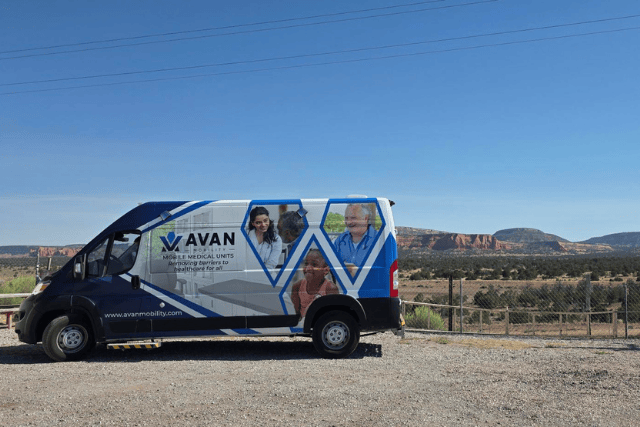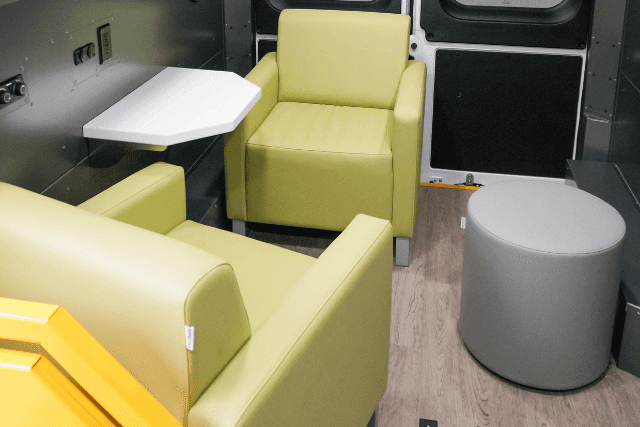
Did you know: In 2022, over 57 million adults in the U.S. experienced a mental illness. But that’s just one piece of the puzzle. Across the country, people are facing all kinds of crises, including mental health, substance use, homelessness, trauma, and when things boil over, they often end up calling 911.
You’re likely here because your organization is looking for a better way to respond. A mobile crisis unit sounds like a smart solution, but maybe you’ve got concerns. That’s completely understandable. Choosing the right vehicle and setup can feel complicated, especially when the stakes are this high.
We’ve talked to organizations just like yours who are worried about:
- Cost: Is this too expensive?
- Logistics: How do we even run something like this?
- Effectiveness: Will it really make a difference?
At AVAN Mobility, we’ve spent over 10 years helping organizations reduce barriers to care with vehicles built for real impact. We work across the U.S., and while we build these units, we know you’ve got options. We’re here to help you sort through the tough questions, no pressure.
In this article, we’ll break down the seven most common objections about mobile crisis units and help you figure out if they are the right fit for your target community.
Objection 1: Staffing and resource challenges
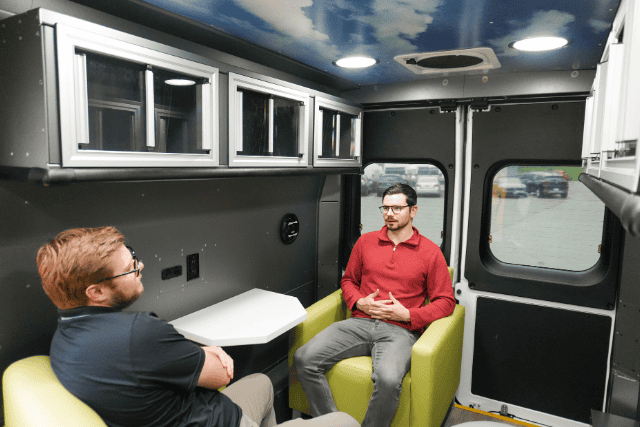
One common objection you might have is, “How are we supposed to staff a mobile crisis unit when we’re already spread thin?” It’s a fair question. When your team is working overtime just to keep up, adding something new can feel out of reach.
Here are a few other common ones potentially lingering around in your mind:
- “Expecting staff to work in unpredictable environments isn’t safe. I don’t think we can guarantee their security out in the field.”
- “Training for mobile crisis response requires time and resources we simply don’t have. It’s unrealistic.”
Totally valid. But here’s the good news: There are ways around this.
Solution: How mobile crisis units make staffing easier, not harder
- Small teams work well: A mobile crisis response team usually includes just two people, a licensed clinician and a peer support worker or responder. Some organizations rotate staff from their regular shifts. Others partner with local agencies to share the load.
- Safety is built in: Mobile crisis units are built for the field. You can customize your vehicle with things like grid bars over the windows, safety dividers, security cameras, and clear front/rear separation. Your team stays protected while doing what they do best.
- Training doesn’t have to take months: You don’t need to start from scratch. Most of your team already has the core skills. Adding mobile crisis training can be done through quick workshops or shadowing shifts.
So yeah, staffing can be a challenge, but it doesn’t have to stop you.
Objection 2: Operational and logistical concerns
Running a mobile crisis unit sounds great on paper, but then reality hits. You start thinking about the day-to-day stuff, like how it would actually work. That’s when the doubts creep in.
Here are a few objections you might’ve had about this:
- “We can’t cover an entire region effectively with just one or two mobile units. It’s impossible to meet demand this way.”
- “Traffic, bad weather, or remote locations could easily delay our response times. That’s a serious liability.”
- “We already have established relationships with local services. Adding a mobile unit will just complicate coordination and create confusion.”
These are all valid concerns. But they’ve been solved before and can be solved again.
Solution: How mobile crisis response teams stay reliable and coordinated
- Start small, scale smart: Most organizations begin with one mobile crisis outreach team and grow from there. It’s not about covering everyone at once; it’s about reaching people faster than a trip to the ER or waiting for police.
- Plan with geography in mind: Before your mobile crisis outreach team heads out, consider the routes and response zones based on traffic patterns, weather risks, and high-need areas. Some even use GPS routing tools or work regionally with nearby teams.
- Mobile doesn’t replace, it connects: A mobile medical unit doesn’t replace your community partners. It helps bridge the gap between them. Mobile crisis teams often work with local shelters, hospitals, and police, not around them.
So no, you don’t need a fleet of 20 vehicles. You just need a smart plan and a unit that helps connect the dots.
Objection 3: Effectiveness and scope of care
Another concern organizations have about a mobile crisis unit is, “Will it actually help?” You want something that works, not a flashy van with no follow-through. We get that.
Here are a few concerns we’ve heard:
- “A mobile unit can’t handle severe mental health crises the way a fully equipped center can. It’s just not sufficient.”
- “What’s the point of a mobile unit if we can’t offer comprehensive care on-site? It feels like a half-measure.”
- “It’s hard enough to ensure follow-up care from our stationary center. Doing that from a mobile unit will be impossible.”
Solution: How mobile crisis outreach teams deliver meaningful care
- Stabilize first, refer second: A mobile crisis response team isn’t trying to be a hospital. It’s there to de-escalate the moment, provide immediate care, and connect people to the next step. Think of it as crisis triage, right where it’s needed.
- On-site care is growing: Many mobile crisis units are equipped to handle more than people expect: Private space for assessments, telehealth hookups, and even space for safely transporting someone to another facility if needed.
- Follow-up is part of the process: Most mobile crisis outreach teams already have protocols in place for follow-up calls, in-person visits, or referrals. Some even work directly with case managers or clinics to track care after the call.
Bottom line? It’s not about doing everything on wheels. It’s about showing up fast, helping in the moment, and guiding people to longer-term care.
Objection 4: Community and stakeholder buy-in
Even if a mobile crisis unit sounds like the right move for your organization, getting others on board can feel like a whole other challenge. It’s hard to lead change when the people around you are unsure, or flat-out hesitant.
Here are a few objections around this:
- “I doubt the community will trust a mobile unit. People are more comfortable coming to a familiar, established center.”
- “Convincing our board and funders to back this is going to be an uphill battle. It’s not worth the effort.”
- “Driving a marked crisis vehicle into neighborhoods might embarrass people and discourage them from seeking help.”
These are all real concerns. But they’re also common and fixable.
Solution: How mobile crisis teams build trust and get support
- Start with the “why”: Boards and funders respond to outcomes. Show them how a mobile crisis unit reduces ER visits, lowers 911 calls, and gets people help faster. A simple pilot program or case study can go a long way.
- Design for dignity: Our vehicles can be marked or unmarked, whatever fits your community best. Some groups go with a neutral design to protect privacy. Others lean into branding to build trust over time. Either way, the look is up to you.
- Trust is earned in the field: People might be unsure at first, but that changes once the mobile crisis outreach team starts showing up, helping, and following through. Consistency builds credibility. Fast.
Introducing something new always takes effort. But when it starts working, others will want to support it.
Objection 5: Legal, regulatory, and insurance
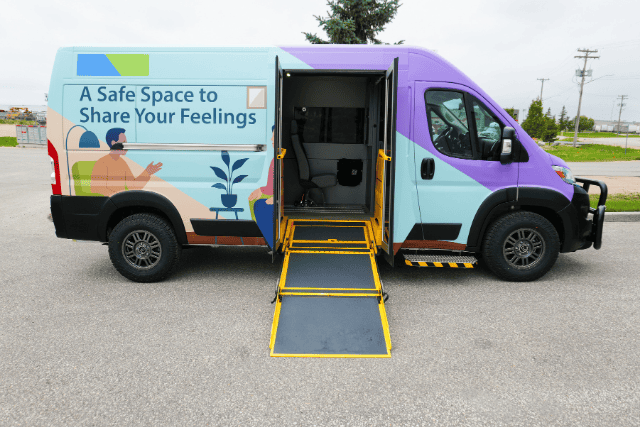
This is the part that makes a lot of organizations pause. You start thinking about risk, paperwork, and liability, and suddenly, a mobile crisis unit sounds like more trouble than it’s worth.
Here are some of the most common concerns:
- “There are too many legal risks with treating people in unpredictable environments. We’re opening ourselves up to lawsuits.”
- “Mobile healthcare delivery comes with complicated regulations. It’s not worth the administrative headache.”
- “Our insurance costs will skyrocket if we add mobile services. That’s not sustainable.”
It can feel overwhelming. But here’s the thing, none of these concerns are new. And you don’t have to figure it all out alone.
Solution: How to manage legal, insurance, and regulatory worries
- Use what others are already doing: There are national models and proven protocols already in place. Most states have guidelines that mobile crisis response teams follow. You don’t need to reinvent anything, just adapt it to your setup.
- Built to be compliant: Our mobile crisis units are built to meet strict vehicle regulations and have Ford QVM and Stellantis Q-Pro certification. We work closely with organizations to make sure everything’s squared away before hitting the road.
- Insurance doesn’t have to break the bank: Many teams find that their existing insurance can be expanded to cover mobile services. It’s usually not as big a jump as expected, and sometimes comes with grant support to help offset the cost.
So yes, there are some hoops to jump through, but nothing you haven’t handled before. And once you’re set up, the long-term benefits far outweigh the early hurdles.
Objection 6: Technology and infrastructure
A mobile crisis unit might sound good in theory, but once you start thinking about all the tech and gear it takes to actually run one… it can feel like a lot.
Here are the kinds of concerns you might have:
- “We won’t have reliable access to patient records or communication tools in the field. That’s a huge risk.”
- “Managing supplies and equipment from a vehicle sounds like a logistical nightmare.”
- “Vehicles break down. What’s the backup plan when our only mobile unit is out of commission?”
These are smart questions, and you’re not the only one asking them.
Solution: How mobile crisis teams stay connected, stocked, and rolling
- Wi-Fi and data systems that go with you: Most mobile crisis outreach teams use vehicles with built-in Wi-Fi, tablets, and cloud-based systems. That means you can pull up records, take notes, and talk with your team, all from the road.
- Organized, efficient storage: Mobile units are designed with smart layouts. Supplies are labeled, locked in storage, and easy to reach. Think of it like a well-organized tool kit, not a junk drawer on wheels.
- Backups and partners: Vehicles do need maintenance, but that’s why many teams have a plan B. Some use rentals, others partner with nearby services to fill gaps. Downtime happens, but it doesn’t stop care from happening.
The truth is, once the systems are set up, most teams find mobile work isn’t harder, it’s just different.
Objection 7: Measuring impact and success
You want to do the right thing, but you also need to prove it’s working. If a mobile crisis unit can’t show real results, it’s hard to justify the cost or effort. That pressure is real.
Maybe these concerns have popped up in your mind:
- “It’s going to be impossible to prove that the mobile unit is making a real difference. We won’t see any tangible ROI.”
- “What if we spend all this money and no one uses the service? That’s a huge waste of resources.”
These are big worries, especially when you’re trying to show value to funders, boards, or partners.
Solution: How mobile crisis response teams track real results
- Clear data from day one: Most mobile crisis units use simple tracking tools; things like call logs, response times, number of people served, and where they’re referred. That kind of data adds up fast and tells a clear story. And even better? You can get mobile office space right in your mobile crisis vehicle to make tracking everything more convenient.
- Impact shows up quickly: Communities that use mobile crisis outreach teams often see fewer police calls, shorter ER visits, and better follow-up rates. Those outcomes are easy to share with stakeholders and powerful in funding reports.
- You’re not guessing, you’re learning: The first few months can feel slow, but they help you spot patterns, adjust routes, and improve service. That kind of feedback loop is what makes these programs better over time.
So yes, you can measure success. And often, the results speak for themselves.
Learn more about mobile crisis units

You landed here because you’ve seen what’s happening across communities in the U.S.: People in desperate need with nowhere to turn. Deep down, you know that for some, a mobile crisis unit might be the only chance to get help when and where they need it.
After reading this, you’ve:
- Uncovered the most common concerns holding organizations back
- Seen that these challenges can be solved
At AVAN Mobility, we’re here to help you change lives. With over a decade of experience, we’ve worked alongside crisis response teams to build units that are safe, efficient, and built for the real world. Our team listens first and builds second, and we’re proud to support the people doing the hardest work in the hardest moments.
Let’s close the gap together. Click the button below to talk with a mobility expert about what’s possible in your community.
Not quite ready? No problem. We’ve got other helpful resources you can explore whenever you’re ready to learn more.
Start by reading through our article on why it’s important for counties to have mobile crisis teams.
After that, check out our article comparing mobile crisis units with stationary crisis centers. This will help you decide if going mobile is the right fit.