Trying to budget for your mobile clinic can feel like trying to solve a puzzle with half the pieces missing. And here’s the kicker: Over 60 million Americans live in rural areas with limited access to care. That’s a huge gap. Your mobile clinic could help close it.
But figuring out the financial part? That’s often where organizations get stuck. Maybe you’re applying for grants, pitching to your board, or pricing out different mobile medical vans. You’re asking, How much do we actually need? What’s realistic? If the budget’s off, your project could stall, or worse, never even get rolling.
The good news is that when you get your budget in order early, everything runs smoothly. You avoid sticker shock later, make smarter choices up front, and move forward with confidence.
At AVAN Mobility, we’ve been building mobile medical clinics and other types of mobile medical vehicles for over 10 years. Organizations across the U.S. trust us, including Pacific Clinics. We don’t build cookie-cutter vans. We build what your community actually needs.
And hey, we know we’re not the only builders out there. This article exists to help you plan smarter, whatever path you take.
Here’s what you’ll learn:
- Budgeting for upfront costs
- Budget for staff and operations
- Keep maintenance, fuel, and insurance in your budget
- Identify funding sources early
- Include a buffer in your budget
How do you budget for your mobile clinic?
Mobile clinics can cost anywhere between $125,000 and $225,000. That’s a big range, right? The price depends on what you’re building, how you plan to use it, and what equipment you need inside.
If that number gave you a bit of sticker shock, you’re not alone. That’s exactly why getting your budget right early on is so important. In this section, you’ll get five practical tips to budget for your mobile clinic without second-guessing every dollar or scrambling later to find extra funds.
Let’s start with your biggest up-front expense: The vehicle and how it’s built.
Tip 1: Budget your upfront costs for the vehicle and upfit
Your biggest upfront cost will almost always be the mobile medical vehicle itself. And the honest truth is that there’s no “one-price-fits-all” number.
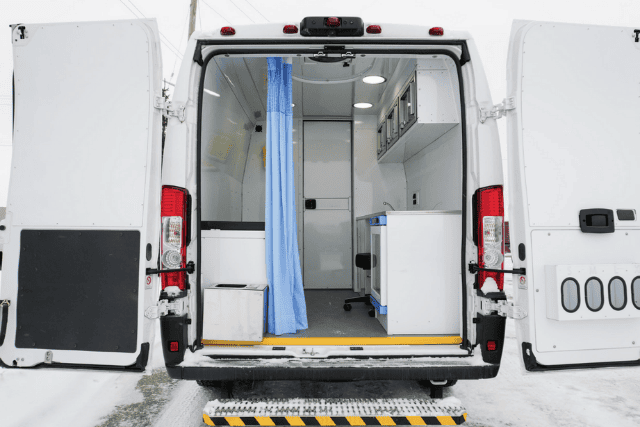
As we mentioned earlier, mobile clinic vans in the U.S. cost between $125,000 and $225,000. That covers the base van and the medical upfitting needed to turn it into a clinic on wheels. Sounds like a lot, but when you break it down, it makes sense.
Here’s where that money goes:
- Base vehicle (van chassis): The chassis accounts for a large part of that budget and depends on the vehicle’s make and model.
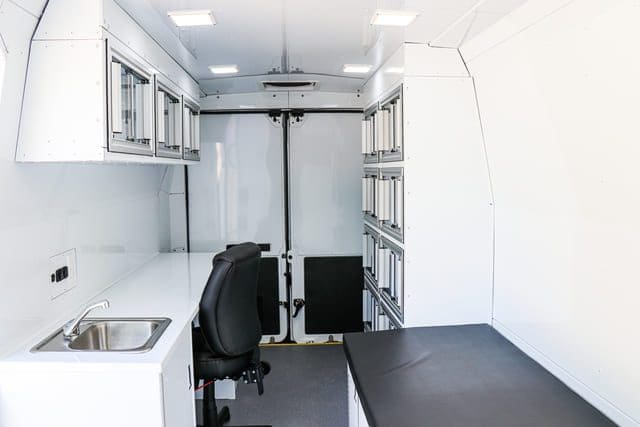
- Medical upfitting: This can range between $30,000–$100,000+, depending on equipment, finishes, and layout.
- Additional tech or features: Advanced equipment, Wi-Fi, solar panels, lifts, or onboard sinks can increase the price.
What else affects the price?
- Size and type of care: A smaller mobile health clinic offering basic health screenings will cost much less than one designed for dental or mammography.
- Custom features: Do you need exterior security features? A waiting area with an awning? Specialized lighting or refrigeration?
- Accessibility: If your clinic will serve people with disabilities, you’ll likely need a wheelchair lift or ramp to make your mobile clinic accessible
Budgeting tips to keep in mind:
- Start with the mission: Know exactly what you want to offer before you build. The clearer your goals, the easier it is to design the right space.
- Avoid “shiny object” upgrades: Stick to what you need to start your program. Also, consider whether you plan to expand your services later down the road. For example, if you plan to offer mobile wound care services now and later switch to a mobile vaccine program, you’ll need a fridge to keep them fresh.
- Plan for shipping and delivery fees too: Some manufacturers charge separately for getting the mobile medical unit to your site.
Bottom line: Don’t let the price scare you. Once you know your needs, your mobile health vehicle can be built to match your budget.
Now, let’s talk about another big cost you’ll deal with every year: Your staff.

Tip 2: Plan for staff and operations as your biggest recurring expense

Once your mobile clinic van hits the road, your highest ongoing cost won’t be fuel or supplies; it’ll be your team. The people inside that van are what make it all work. And paying for good staff? That adds up fast.
On average, operating a mobile medical clinic in the U.S. costs about $275,000 per year. Most of that goes straight into staffing. We’re talking salaries, benefits, training, travel time, and everything else it takes to keep your people showing up and serving the community.
Common staff roles include:
- Driver (sometimes this is also a nurse or outreach worker)
- Medical assistant or nurse
- Nurse practitioner or physician assistant
- Administrative support
- Social worker or case manager
Depending on the type of care your mobile medical unit provides, you might also need mental health specialists, lab techs, or interpreters.
Here’s how staffing affects your budget:
- Smaller teams = lower cost but possibly fewer services
- Larger teams = higher cost but more comprehensive care
- Hiring locally can cut down on travel expenses
- Overtime, turnover, or burnout can sneak up and blow past your budget
Other operational expenses to include:
- Training and certifications: Keeping your staff licensed and current
- Scheduling software or EMRs: Helps track patient data and appointments
- Uniforms, tablets, and phones: Stuff your team needs to do their job well
- Travel time compensation: Especially if your routes cover wide rural areas
Don’t forget: Even if you’re using volunteers or part-time staff, there are still costs involved: Training, background checks, equipment, and coordination time.
Staffing makes or breaks a program. So as you budget for your mobile clinic, make sure your people have what they need to do their jobs safely, effectively, and with heart.
Coming up next: the hidden costs no one tells you about, but absolutely should.
Tip 3: Include maintenance, fuel, supplies, and insurance in your budget
These are the costs that sneak up on people. You’ve got your Mobile Clinic Van. You’ve got your team. But then, bam, something breaks, gas prices jump, or you constantly run out of medical gloves and other supplies. These are the small (but constant) things that keep your mobile medical clinic rolling… or stop it in its tracks.
Let’s break it down.
Common recurring costs to plan for:
- Fuel: Mobile medical vans aren’t exactly hybrids. If you’re covering a large rural area, this adds up fast.
- Maintenance: Oil changes, tire replacements, brake work, or fixing that mystery rattle.
- Repairs: Unexpected stuff like generator issues or electrical problems.
- Medical supplies: PPE, syringes, test kits, cleaning products, and disposables like exam table paper.
- Admin supplies: Clipboards, pens, intake forms, hand sanitizer, and printer ink.
- Insurance: For both the vehicle and your staff’s liability.
Rough cost range? Try to budget between $30,000 and $60,000+ per year for these types of operational needs. But if your mobile medical unit travels often or provides higher-touch services (like wound care or diagnostics), that number climbs.
Tips to keep these costs under control:
- Set up a maintenance schedule: Prevent small issues from turning into big breakdowns.
- Buy supplies in bulk: You can often get discounts, especially on PPE or cleaning materials.
- Track fuel use: Use apps or logs to find out if routes need adjusting or if your van’s guzzling more than it should.
- Bundle insurance where you can: Some providers offer multi-vehicle or nonprofit discounts.
Forgetting to budget for these costs can result in some mobile health programs running short on funds. So when you budget for your mobile clinic, treat these like non-negotiables.
In the next section, we’ll talk about some sources where the money comes from and how to find more of it.
Tip 4: Identify and secure diverse funding sources early
Let’s talk about money. Because budgeting for your mobile clinic isn’t just about what you spend, it’s also about where the money comes from. And if you’re counting on one grant to cover it all, you might be in for a rough ride.
The most successful programs pull from multiple funding sources. That way, if one drops off, your mobile health clinic doesn’t grind to a halt. Plus, some grants won’t cover certain things, like staff salaries or vehicle maintenance, so spreading things out gives you more flexibility.
Here are some common funding options:
- Private foundations: Think United Way, the Robert Wood Johnson Foundation, or state-based health foundations.
- Hospital or university partnerships: Great if you’re providing services that help their outreach or research.
- Billing for services: Medicaid, Medicare, or sliding-scale fees if you qualify as a provider.
- Corporate sponsorships or community donors: Especially helpful for buying equipment or covering setup costs.
- Fundraisers: Events, donation drives, or online campaigns can build awareness and cash.
Tips to boost your chances:
- Start early: Grant deadlines and application windows can take months.
- Get help writing grants: If that’s not your thing, hire a freelancer or ask a partner organization.
- Track your impact: Funders love to see real numbers. Keep data on how many people you serve, the types of care you provide, and the outcomes.
Depending on grants alone can leave you scrambling year to year. But if you build a mix of funding streams, your mobile medical unit can grow, expand, and survive long term, even when surprises hit.
Next up: How to protect your budget from the unexpected with one simple trick.
Tip 5: Build in a buffer and review your budget regularly
When it comes to budgeting, things sometimes don’t go according to plan. Prices jump. Equipment breaks. Routes change. That’s why one of the smartest ways to budget for your mobile clinic is to leave some wiggle room.
We’re talking about a buffer.
That little safety net in your budget could be the thing that keeps your mobile health unit rolling when the unexpected hits.
How much should you set aside? It’s safe to aim for a 10% to 20% buffer on top of your total budget. So, if your estimated yearly cost is $300,000, try to leave an extra $30,000 to $60,000 untouched. This isn’t money to waste; it’s a safeguard in case unexpected situations arise.
Things that might eat into your buffer:
- Fuel price spikes
- Costlier-than-expected repairs
- Staff turnover or emergency hires
- Delays in grant payouts
- New compliance or licensing requirements
Keep in mind that budgeting isn’t set-it-and-forget-it. Once your mobile medical vehicle is on the road, things change. You’ll learn more about what you need, what you don’t, and where money gets wasted.
Quick tips to stay on track:
- Check your budget monthly: Spot problems early before they become big.
- Use budget software or a good ol’ spreadsheet: Keep it simple and updated.
- Meet with your team: Ask your staff where money is going and what’s really needed.
- Adjust yearly: Treat your budget like a living thing, not a locked-in number.
You can’t predict everything, but you can prepare for most of it. Building in a cushion and checking your numbers often helps your mobile health clinic stay flexible, reliable, and ready to serve.
Got any questions about mobile clinic budgeting?
You came here because budgeting for your mobile clinic felt confusing or overwhelming. Maybe you weren’t sure where to start or worried about missing costs that could stall your project. That’s a common challenge.
After reading this article, you’ve learned:
- How to budget upfront costs for your mobile clinic van and upfit
- Why staffing and operations take up the biggest slice of your budget
- Which hidden expenses, like maintenance, fuel, and insurance, to plan for
- How to secure diverse funding sources early to avoid surprises
- The importance of building a budget buffer and reviewing it regularly
At AVAN Mobility, we know budgeting is more than numbers. For over a decade, we’ve partnered with organizations like yours across the U.S. to build mobile healthcare units that work hard and last long. We listen closely to your unique needs and design vehicles that fit your mission and community, not the other way around. Our hands-on approach doesn’t stop when the keys are handed over. We support you with service, advice, and care every mile of the way.
That’s why we lead the industry in delivering mobile medical vehicles that reduce barriers and save lives. If you have questions or want to talk about next steps, click the button below to connect with a mobility expert.
If you’re not ready to talk just yet, check out these helpful resources to keep learning:
- Top 10 tips on fundraising for a Mobile Clinic Van: Learn practical fundraising ideas to help cover startup and ongoing expenses.
- What does a day look like? Prepare for your Discovery Call with AVAN: You’ll learn what to expect during your Discovery Call with us.
- Buying a mobile medical van—Your process with AVAN Mobility: Understand what happens from your first call to driving away in your new mobile health vehicle.