Are you being asked to do more with less and still prove results? The impact of mobile clinics matters when fixed sites can’t reach everyone and gaps keep growing. In the U.S., over 30 million people live in healthcare deserts according to the U.S. Department of Health and Human Services. That’s not abstract data. It shows up as missed appointments, late diagnoses, staff burnout, and pressure from boards asking for proof before funding anything new. If that gap stays open, outcomes slip and trust erodes.
The desired state feels clear:
- Care reaches people earlier
- Programs show real numbers
- Communities feel seen
Data suggests mobile healthcare can help close that distance, often faster than brick-and-mortar clinics.
At AVAN Mobility, you’re talking to a team that’s been building mobile medical units for over 10 years. We’ve manufactured more than 150 mobile medical units used across the country, supporting organizations like CalOptima, Pacific Clinics, Siskiyou County, and the Community Clinic of Southwest Missouri. Our Ford Pro Upfitter and Stellantis QPro certifications reflect how seriously we take safety and real-world use. We also know we’re not the only option out there, so this conversation stays grounded in data.
In this article, you’ll learn what the numbers say about mobile clinics, including:
- Access: How mobile health clinics reach underserved areas.
- Outcomes: What improves when care comes closer.
- Costs: How programs compare over time.
How does the impact of mobile clinics show up in access across underserved U.S. communities?
When access is the gap, speed and proximity matter. The data shows the impact of mobile clinics is often simplest to measure here: they bring a mobile health clinic to the places people already are.
Nationally, Mobile Health Map estimates there are about 3,000 mobile clinics in the U.S. delivering around 10 million visits each year. That’s not a niche model anymore. It’s a real part of the safety net.

Here’s what that access looks like in plain numbers:
- Scale: Many mobile health clinics run thousands of visits per year. A large review of U.S. mobile health clinics reported a median of 3,491 visits annually per clinic.
- Who gets reached: In that same review, clients were often groups that face access barriers, including 59% racial/ethnic minorities, and a large share without stable coverage: 41% uninsured and 44% on public insurance (among clinics reporting insurance data).
- Rural reach: A Mobile Health Map report notes that about one-third of mobile clinics serve rural areas. That matters in places where the nearest clinic can be a long drive, and transportation can be the real “no-show” reason.
Why this matters for you: If you’re serving rural counties in Appalachia, the Great Plains, or parts of the Southwest, access often means travel time, missed work, and patients putting off care until it gets serious. If you’re serving dense cities like Los Angeles, Houston, or New York, access can mean long wait times, complicated transit, and families choosing between a visit and a paycheck. A mobile medical clinic helps you meet people where life is already happening.
What does access data tell you about where a mobile clinic van fits?
The gap usually looks like this: your team has services, but the community can’t reliably reach them. Mobile healthcare flips that. You move the care closer.
Here are the access wins the data supports:
- You reduce distance friction: Mobile clinics operate inside neighborhoods, worksites, shelters, and community hubs, which is the point where transportation is the barrier.
- You reach people who fall through the cracks: The national data shows mobile health clinics commonly serve patients with limited coverage or none at all. That’s often where gaps show up first.
- You add capacity without waiting years: Many organizations use a mobile medical unit to extend a network fast, then adjust routes based on demand. That flexibility is a big reason this model has grown inside health centers, too.
Quick gut-check for your planning team: If your programs rely on patients driving 45 to 90 minutes, finding childcare, or navigating transit just to get basic screening, access will stay your bottleneck. A mobile clinic can turn that bottleneck into a route plan.
Next up, we’ll get into outcomes: what the data says changes when care gets closer.
Does healthcare improve when care is closer?
When healthcare comes closer, people use it sooner and more often. That’s where the impact of mobile clinics becomes even clearer. A mobile health clinic removes daily barriers like long travel, missed work, and confusing systems. The data shows this shift leads to better prevention, steadier care, and fewer emergencies.
People get care earlier, before problems grow
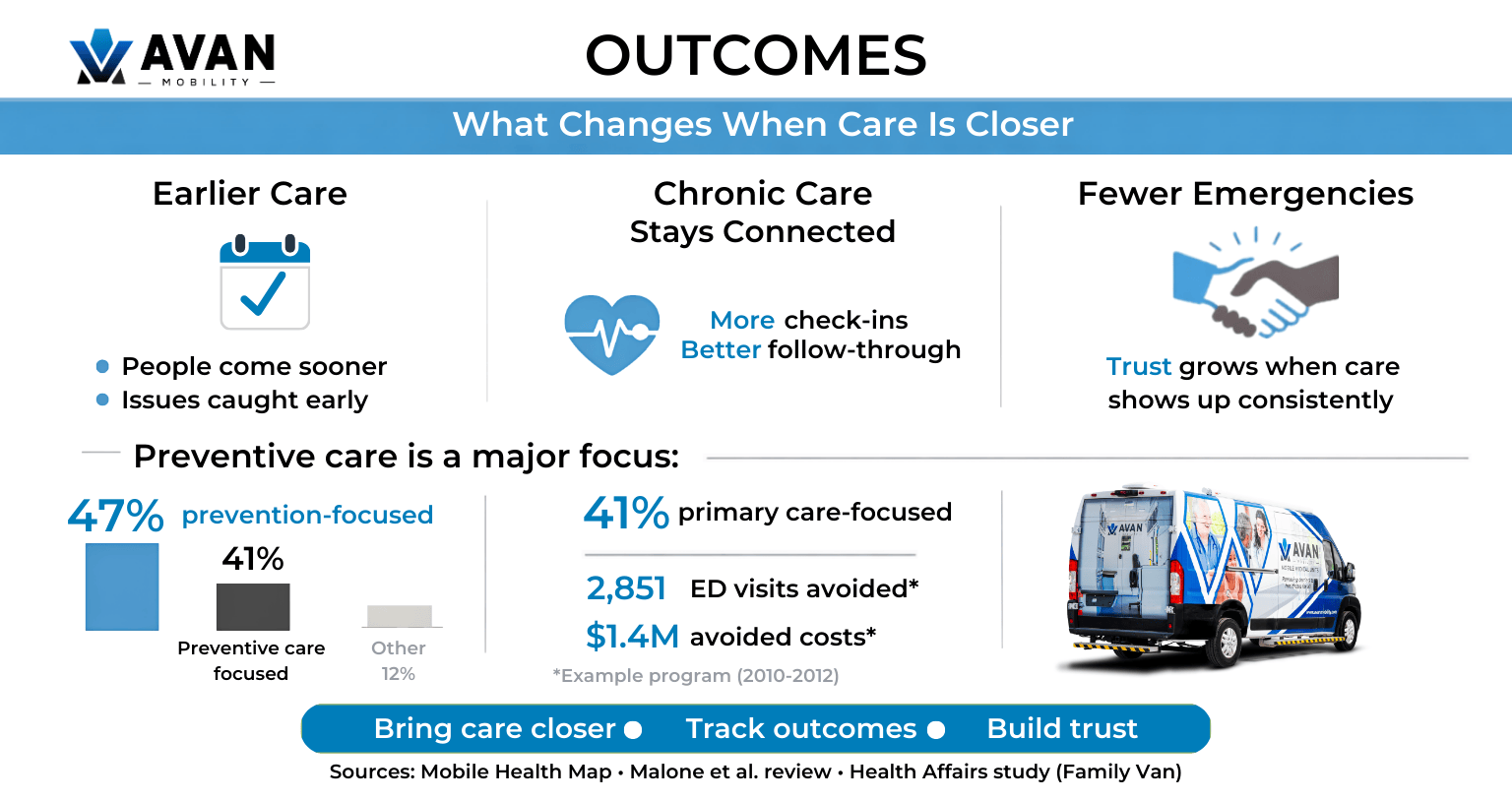
Preventive care improves when services are nearby. According to Mobile Health Map, mobile clinics across the U.S. deliver millions of preventive services each year, including screenings, vaccines, and basic checkups.
Why earlier care happens:
- Proximity: Care shows up at schools, community centers, shelters, and worksites.
- Lower friction: Fewer rides, less time off work, and simpler visits.
- Higher follow-through: When a clinic is closed, people show up.
This matters because earlier screenings catch issues sooner, when care is simpler, and outcomes improve.
People with chronic conditions stay connected
Chronic care depends on regular touchpoints. Mobile clinics help keep those connections steady.
The Mobile Health Map Impact Tracker shows mobile clinics routinely connect patients to follow-up care and ongoing services, supporting people with diabetes, hypertension, asthma, and behavioral health needs.
What improves with closer care?
- Consistency: Patients are more likely to return for check-ins.
- Stability: Conditions are monitored before they spiral.
- Continuity: Mobile clinics often serve as a reliable entry point into the care system.
When care fits into daily life, people are more likely to stick with it.
Emergency room visits drop when care is reachable
One of the strongest data signals is fewer avoidable emergency visits.
A review found that mobile clinics are linked to reductions in unnecessary emergency department use by addressing needs earlier and outside hospital settings.
What does this tell you?
- Prevention works: Small issues get addressed sooner.
- Costs stabilize: Fewer ED visits reduce strain on systems.
- Patients avoid crisis care: Care feels available before it’s urgent.
Trust and follow-through improve over time
Outcomes improve when people trust the care they receive. Mobile clinics build that trust by showing up consistently in familiar places.
Research published in Public Health Reports shows mobile clinics often become a person’s first regular source of care, especially for uninsured and publicly insured populations. That consistency supports better long-term engagement.
What does trust change?
- People return sooner: Symptoms don’t linger.
- Referrals stick: Patients follow through more often.
- Engagement grows: Care feels approachable, not intimidating.
This is especially important for behavioral health and community-based services, where comfort and familiarity shape outcomes.
The numbers that bring it together
Here’s a quick snapshot of what national data shows when care comes closer:
- About 10 million visits each year: Estimated annual visits delivered by mobile health clinics in the U.S.
- Strong preventive focus: Screenings, vaccines, and primary care make up a large share of mobile clinic services.
- Lower avoidable acute care use: Research links mobile clinics with fewer unnecessary ED visits.
If you’re responsible for outcomes, the message is simple. When care is closer, people use it. When people use it earlier, outcomes improve. The data shows the impact of mobile clinics goes beyond access. It changes behavior, builds trust, and reduces emergencies.
Next, we’ll look at what the numbers say about costs and long-term sustainability for organizations using mobile clinics.
What does the data say about costs and long-term sustainability of mobile clinics?
Cost questions usually come first. You’re being asked to reach more people, show better outcomes, and still stay within budget. The impact of mobile clinics matters here because leaders need a model that works today and still makes sense years from now.
The data from U.S. programs shows mobile clinics often cost less to start, adapt faster, and help avoid expensive care later. That’s why many organizations treat a mobile medical clinic as a long-term tool, not a short-term project.
Mobile clinics usually cost less to start than buildings
Building a clinic takes time, money, and long-term commitment to one location. A mobile clinic moves faster.
Research from Harvard Medical School and Mobile Health Map shows mobile clinics operate with lower overhead costs than fixed sites because they avoid construction, large facilities, and ongoing building expenses.
Why are startup costs lower?
- No construction: You don’t wait years to open doors.
- Lower fixed expenses: Less spending on utilities and real estate.
- More flexibility: One mobile clinic can serve many locations.
This gives you room to launch sooner and adjust without locking into a permanent footprint.
Preventive care helps avoid expensive emergency care
The biggest cost story shows up time and time again after the clinic is on the road. Preventive care costs far less than emergency care.
A Health Affairs-published study of The Family Van showed cost savings from improved blood pressure control and about $1.4 million in avoided ER visits over 2010–2012, reinforcing the reduction in costly acute care when mobile clinics bring services closer to communities.
Where do savings come from?
- Earlier care: Issues are treated before they turn serious.
- Fewer ER visits: Patients don’t wait until it’s urgent.
- Lower hospital use: Chronic conditions are managed.
For organizations that monitor the total cost of care, these avoided expenses are significant.
A mobile clinic van uses resources more efficiently
A building serves one address. A mobile clinic van serves many. That changes how far your resources can go.
Mobile Health Map reports that mobile clinics deliver thousands of visits per year and adjust routes based on community demand.
Why this supports long-term use:
- Routes change: You go where the need is highest.
- Services shift: Focus changes as community needs change.
- Assets stay useful: You’re not stuck with an empty site.
This flexibility helps when funding shifts, population needs change, or programs grow.
Mobile clinics support value-based care goals
Many organizations now focus on outcomes, not volume. The impact of mobile clinics fits well with value-based care.
Research published in The American Journal of Managed Care shows mobile clinics support population health by improving preventive care and lowering high-cost emergency use.
How mobile clinics help value-based goals:
- Better prevention: Screenings and follow-ups increase.
- Lower total costs: Emergency care drops.
- Clear reporting: Visits and outcomes are easy to track.
This makes it easier to explain the value of a mobile clinic to boards and funders.
Funding models help mobile clinics last
Long-term success depends on steady funding. Most mobile clinics use more than one source.
Many U.S. programs combine reimbursements, grants, contracts, and partnerships to support operations.
Common funding sources include:
- Medicaid and Medicare billing for eligible services
- Public health contracts at the county or state level
- Grants and donations for targeted outreach
- Health system partnerships that extend existing care
This mix helps reduce risk and supports stability over time.
As you can see after reviewing all of these numbers, mobile clinics result in:
- Lower upfront costs than building clinics
- Real savings from avoided emergency care
- Flexible use as needs change
- Strong fit with value-based care models
Want to learn more about the impact of mobile clinics?
You came here because access gaps, rising costs, and pressure to prove outcomes are real. You needed to know if the impact of mobile clinics is backed by data or just talk. The numbers matter when decisions affect people, budgets, and long-term trust.
Here’s what you learned from the data:
- Access improves: Mobile clinics reach people missed by fixed sites.
- Outcomes get better: Earlier care leads to fewer emergencies.
- Costs stay in check: Prevention and flexibility support long-term sustainability.
At AVAN Mobility, we spend our days working alongside organizations navigating these exact decisions. For more than a decade, we’ve partnered with healthcare teams across the U.S. to turn data, funding goals, and community needs into mobile solutions that actually work in the real world. Our approach starts with listening, then building around how care is delivered on the ground. Every unit reflects one belief we stand behind: removing barriers saves lives. If you have questions or want to talk through what this could look like for your organization, click the button below to connect with a mobility expert.
If you’re not ready to talk with a mobility expert yet, we have a few other resources you should check out to keep learning.
Recommended next reads
- How much does a mobile medical unit cost in the U.S.? Reading this will give you an idea of what you can expect to pay for a mobile clinic.
- Mobile medical clinics vs. traditional clinics: This article gives you a look at how mobile clinics perform against fixed sites when it comes to access, outcomes, and sustainability.
- Buying a mobile medical van: Your process with AVAN Mobility: This walks you through what the purchasing process actually looks like, so there are no surprises later.