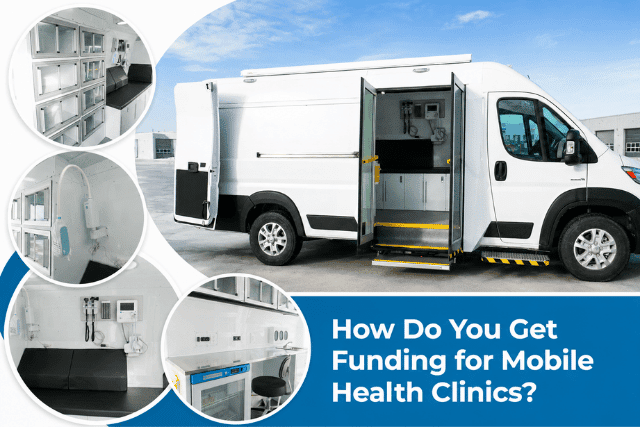
Funding for mobile health clinics can feel hard to find when your community already needs care now. The CDC says 1 in 5 Americans live in rural areas, where many people face longer drives, fewer providers, and higher health risks. That gap puts pressure on your team. You may have the plan, the staff, and the right heart behind the work, but without funding, the mobile clinic you’re interested in stays parked on paper. We know how tough it can be to find mobile health clinic funding. The good news? With the right funding path, your program can bring care closer to the people who’ve waited long enough.
Our team at AVAN Mobility has spent over 10 years helping healthcare teams, governments, and non-profits remove barriers to care. We’ve built over 180 mobile medical units for organizations like CalOptima, the Community Clinic of Southwest Missouri, Siskiyou County, and Pacific Clinics. We’re also a Ford Pro Upfitter and Stellantis QPro certified builder. We know we’re one option in the market, so this article is here to help you make an informed funding decision.
In this article, you’ll learn where to look for:
- Federal grants
- State and local funding
- Private foundations
- Partnerships and community support
Federal funding for mobile health clinics
Federal funding for mobile health clinics can help you move from “we know our community needs care” to “we have a real path to bring care closer.” These grants can support different parts of a mobile program, from rural care and primary care to behavioral health, crisis response, workforce training, and service expansion.
The key is knowing which federal grants actually support mobile health clinics, because not every healthcare grant fits a mobile model. Some are built for health centers, some for rural communities, and some for mobile crisis teams, so the right fit depends on your program, your patients, and the gap you’re trying to close.
Let’s take a closer look at federal funding opportunities that can get your mobile health clinic rolling.
1. USDA Community Facilities Direct Loan and Grant Program
If you’re looking for funding for mobile health clinics that can help cover the actual mobile clinic vehicle, the USDA Community Facilities Direct Loan and Grant Program is one of the strongest federal places to start. It’s built for rural communities that need essential services, including healthcare facilities, medical clinics, dental clinics, and related equipment. USDA says Community Facilities funding can support essential healthcare services for rural communities, and financing may cover equipment and related project costs.
What does it fund?
This program can provide direct loans, grants, or a mix of both to develop essential community facilities in rural areas. Funds may be used to purchase, construct, or improve facilities, and RHIhub lists healthcare facilities such as hospitals, medical clinics, dental clinics, nursing homes, and assisted living facilities as examples. For a mobile health clinic, this could support the vehicle and clinical equipment when the mobile unit is part of an eligible rural healthcare service project.
Who can apply?
Eligible applicants include public bodies, nonprofit corporations, and federally recognized Tribes. The project must serve a rural area or town with a population of up to 20,000 people. This makes it a strong fit for rural counties, Tribal governments, community-based nonprofits, and rural healthcare organizations trying to close care gaps.
Deadline dates to know
Applications are accepted on an ongoing basis, so there’s no single annual deadline to chase. That’s helpful when your funding timeline doesn’t line up neatly with grant season, because grant season rarely checks your calendar before causing chaos.
Important criteria:
- Location: Your project must serve an eligible rural area.
- Use: The mobile clinic must support an essential community service.
- Applicant type: Public bodies, nonprofits, and federally recognized Tribes are the main fit.
- Funding mix: Grants are usually limited and based on community size and income, so many projects use a loan and grant combination.
- First step: Contact your USDA Rural Development state office before building the full application. RHIhub notes that applicants should begin by contacting the proper state office to discuss the project.
Who is this funding best for?
This is a strong fit if your rural community needs a mobile medical clinic, mobile dental clinic, behavioral health van, or preventive care unit that brings care closer to patients. For example, a county in rural Mississippi could use this type of funding to help launch a mobile clinic that rotates between small towns where patients may otherwise drive hours for basic care.
Quick note: This is currently open and can support capital costs tied to rural healthcare facilities and equipment. Since mobile clinic vehicle approval can depend on how your project is structured, your safest first move is to confirm the vehicle cost with your USDA state office before writing the full request.
2. USDA Rural Economic Development Loan and Grant Program
The USDA Rural Economic Development Loan and Grant Program can be a fit for funding for mobile health clinics when the mobile clinic vehicle is part of a rural medical care project that creates or keeps jobs. This program doesn’t work like a normal grant where your health organization applies straight to USDA. Instead, USDA provides funding through eligible rural utility organizations, and those utilities pass the funding to local projects.
What does it fund?
This program can fund rural projects that support economic development and job creation. USDA lists facilities and equipment for medical care for rural residents as an eligible use. It also lists start-up venture costs, including fixed assets like equipment or working capital. That’s the part that can make a mobile medical clinic vehicle a possible fit when the vehicle is tied to rural healthcare access and job creation.
Who can apply?
The direct USDA applicant must be an eligible utility, such as a current or former Rural Utilities Service electric or telecommunications borrower, or an eligible not-for-profit utility. Your healthcare organization would usually be the ultimate recipient, meaning the local utility applies and then lends the funding to your project.
What deadline dates should you know?
The program is currently listed as open. USDA lists quarterly application deadlines for complete applications to reach the Rural Development state office. The next listed deadline is June 30, 2026.
What criteria should you know?
- Rural area: Projects must serve rural areas or towns with fewer than 50,000 residents.
- Job impact: The project must create or retain rural jobs.
- Funding path: You’ll need an eligible local utility partner.
- Project fit: The mobile clinic vehicle should be framed as medical care equipment or a fixed asset for rural healthcare delivery.
- Funding structure: REDL can provide up to $1 million in zero-interest loan funding to the utility, which then passes it to the local project.
Who is this funding best for?
This is a strong fit for a rural health organization that has a local utility partner and can show how the mobile clinic vehicle improves care while supporting jobs. For example, a rural health nonprofit in Arkansas may use this route to launch a mobile clinic that brings primary care and screenings to small towns, while also adding staff roles for nurses, drivers, or care coordinators.
Quick note: Keep in mind that this funding opportunity should be seen as a conditional fit. It supports medical care facilities and equipment, but the mobile clinic vehicle should be confirmed with the USDA Rural Development state office before the organization treats it as a locked funding source.
State and local funding for mobile health clinics
State and local funding for mobile health clinics can be a strong next step when federal grants are too narrow, too slow, or already closed. These funding sources often come through state health departments, counties, cities, opioid settlement funds, rural health programs, and local public health budgets.
1. State opioid settlement funds
State opioid settlement funds can be a strong source of funding for mobile health clinics when the mobile clinic vehicle supports opioid treatment, harm reduction, recovery services, wound care, outreach, or medications for opioid use disorder. These funds are managed by each state, city, or county, so the best place to start is the Opioid Settlement Tracker, then click through to your state’s official opioid settlement page.
What does it fund?
Opioid settlement funds are meant to support opioid remediation. That can include treatment, recovery, prevention, harm reduction, and other programs that reduce the impact of the opioid crisis. Most opioid settlement guidance says funds are intended for opioid remediation activities, including care, treatment, and programs that address opioid misuse and opioid-related harms.
For mobile clinics, the vehicle can fit when it directly supports eligible opioid response work. The City of Minneapolis gives a clear real-world example. Its Mobile Medical Unit brings treatment and resources to underserved communities and offers services such as basic health screening, wound care, vaccinations, treatment resources, and access to medications for opioid use disorder.
This depends on the state, county, or city that controls the funds. In many cases, the funding may support:
- Local health departments: City or county public health teams.
- Non-profits: Groups serving people affected by opioid use.
- Healthcare providers: Clinics, FQHCs, hospitals, and recovery programs.
- Tribal governments: Depending on the state’s settlement structure.
- Community partners: Outreach, harm reduction, and treatment groups.
Some areas open public grant rounds. Others fund projects through local budgets, public health plans, contracts, or board-approved spending.
What deadline dates should you know?
Deadlines vary by state and local government. Some open annual grant cycles. Others accept proposals through county health departments or city budget processes.
A good first step is to check your state’s opioid settlement dashboard, then look for local city or county funding rounds. California, for example, explains that opioid settlement funds are split between state and local recipients, with 70% going to participating subdivisions through the California Abatement Accounts Fund.
What criteria should you know?
- Use of funds: Your mobile clinic should connect directly to opioid remediation.
- Proof of need: Show overdose rates, treatment gaps, rural access issues, or high-risk areas.
- Local alignment: Tie the mobile clinic to your state, county, or city opioid response plan.
- Reporting: Be ready to track visits, services, outcomes, and locations served.
- Vehicle fit: Make it clear that the mobile clinic vehicle is the tool that brings treatment and support to the community.
Who is this funding best for?
This funding is a strong fit if your mobile clinic will support people affected by substance use, homelessness, rural isolation, or poor access to treatment. Picture a county health department in Ohio using a mobile medical unit to bring wound care, testing, naloxone, and recovery support to smaller towns. The gap is simple: people need help, but many won’t walk through a clinic door. A mobile unit helps your team meet them with dignity, privacy, and care.
Quick note: This is a funding source at the state and local level, not one single national application. The dollars come from opioid settlements, but each state and local government controls its own process.
2. Rural health transformation program
The Rural Health Transformation Program is a federal-to-state funding stream that can support funding for mobile health clinics, including mobile clinic vehicles. CMS awarded funding to all 50 states, and states will use those funds from 2026 through 2030 to improve rural healthcare access, modernize care, and support new care models.
What does it fund?
CMS says states can use Rural Health Transformation Program funds for approved uses tied to prevention, chronic disease care, behavioral health, substance use treatment, workforce support, rural care access, technology, and innovative care models. CMS also says states must use funds for at least three approved uses.
For mobile clinics, the key detail is that mobile health units are being included in state plans. The National Association of Rural Health Clinics says mobile health units were explicitly identified as an entity that RHTP funds can go toward to support population health. It also notes that 42 states included mobile health in their RHTP applications across service areas like primary care, dental, behavioral health, mammography, stroke response, and mobile integrated health.
Who can apply?
Healthcare organizations usually won’t apply directly to CMS for this funding. CMS awarded the money to states, so your path will be through your state health department, state Medicaid agency, rural health office, or a state-run grant, contract, or procurement process. CMS states that only the 50 U.S. states are eligible to receive Rural Health Transformation Program awards.
That means this funding can still help your mobile clinic project, but your first move is state-level research. Look for your state’s Rural Health Transformation Program page, application summary, project abstracts, procurement notices, and subaward opportunities.
What deadline dates should you know?
CMS announced that all 50 states received awards on December 29, 2025. The program runs for five fiscal years, with $10 billion available each year from 2026 through 2030.
The deadlines that matter now are state deadlines. Some states may open grant applications, some may issue requests for proposals, and others may run projects through state agencies or partner organizations.
For example, Idaho’s Rural Health Transformation Program page lists “vehicles for patient transport and rural mobile health units” under rural health infrastructure and partnerships, which shows how state-level plans can name vehicle costs directly.
What criteria should you know?
- Rural focus: Your mobile clinic should serve rural communities.
- State alignment: Your project should match your state’s RHT plan.
- Population health: Mobile clinics may be strongest when tied to prevention, chronic disease, behavioral health, maternal care, dental care, or substance use treatment.
- Proof of access gap: Show the distance, wait times, provider shortages, or transportation barriers your mobile clinic will solve.
- Vehicle cost clarity: Spell out the vehicle, buildout, medical equipment, and service model so the state can see the full care pathway.
Who is this funding best for?
This funding is best for rural healthcare organizations, FQHCs, hospitals, rural health clinics, county health teams, and community partners that want to expand care outside clinic walls. Think of a rural health clinic in Idaho using a mobile unit to bring primary care, screenings, and follow-up care to communities that are too far from the main clinic.
The gap is practical and human. Patients may know they need care, but a two-hour drive, a missed shift, or no transportation can stop them cold. A mobile clinic helps bring care closer, which is the whole point of mobile health clinic funding in the first place.
Quick note: Readers should click their state’s RHT page or contact their state health department to find the actual application path.
3. Community development block grant program
The Community Development Block Grant Program, often called CDBG, can support funding for mobile clinics when the mobile clinic vehicle helps low- and moderate-income residents access healthcare. This is a flexible funding source, but it’s usually managed by states, cities, counties, or local development agencies, so your application path depends on where your program will serve.
What does it fund?
CDBG funds can support local projects that help low- and moderate-income people, prevent or remove slum and blight, or address urgent community needs. Healthcare can fit when the project clearly supports eligible community development goals.
For mobile clinics, there are real examples. Nebraska’s Department of Economic Development awarded $362,600 in CDBG funding to the City of Atkinson to help West Holt Medical Services complete a mobile health clinic for rural communities in northern Nebraska. Shelby County, Alabama also used CDBG-CV funding for a mobile testing and vaccination clinic to serve underserved, at-risk, and rural residents.
Who can apply?
This depends on the local or state program. In many cases, the direct applicant is a:
- City or county government: Often the official applicant for local CDBG funds.
- State agency: Usually for smaller communities or rural areas.
- Non-profit partner: Often works with a city, county, or state applicant.
- Healthcare provider: May be included as the service provider or project partner.
For example, the Nebraska mobile clinic project was awarded to the City of Atkinson, while West Holt Medical Services used the mobile clinic to deliver care. That kind of partnership can make CDBG a strong path for mobile health clinic funding.
What deadline dates should you know?
Deadlines vary by state, county, and city. Some communities run annual CDBG cycles, while others release special rounds for urgent needs, disaster recovery, or public health response.
Montgomery County, Maryland, says its CDBG application cycle typically opens in August and closes in September, which is a good example of how local timelines can work. Your best move is to search your city, county, or state name with “CDBG application” and “healthcare” or “mobile clinic.”
What criteria should you know?
- Community benefit: Your project must serve an eligible local need.
- Income focus: Many projects must benefit low- and moderate-income residents.
- Local control: The city, county, or state sets the local process.
- Public purpose: The mobile clinic should support healthcare access, prevention, testing, or treatment.
- Partnerships: A healthcare organization may need to partner with a public agency.
Who is this funding best for?
CDBG can be a strong fit if your mobile clinic will serve low-income neighborhoods, rural towns, migrant communities, unhoused residents, or areas with limited healthcare access. Picture a small county in Nebraska where patients need basic care, but the nearest clinic is a long drive away. A mobile clinic funded through CDBG can help bring care closer without asking people to solve a transportation problem before they can solve a health problem.
Quick note: CDBG is flexible, but it’s not automatic. You’ll need to show how the mobile clinic vehicle supports an eligible community development goal and fits your local program rules.
Private foundations for mobile health clinics

Private foundations can be a strong source of funding for mobile clinics, especially when your mobile clinic supports health equity, rural access, children’s health, behavioral health, dental care, or care for underserved communities. These grants are often less rigid than government funding, but they usually depend on your location, population served, and how clearly your mobile clinic vehicle solves a real access gap.
1. Community Partnership Fund through the Community Foundation of North Central Washington
The Community Partnership Fund is a strong private foundation example because it has directly helped fund a mobile healthcare vehicle. Cascade Medical Foundation received a $10,000 grant from the Confluence Health and Wenatchee Valley Medical Group Community Partnership Fund to help purchase a vehicle for Cascade Medical’s Mobile Integrated Health Program.
What does it fund?
This fund supports projects focused on health and wellness, education, and arts and culture in North Central Washington. In the Cascade Medical example, the grant helped purchase a specially outfitted vehicle for a Mobile Integrated Health Program that brings care to rural residents, seniors, people with chronic conditions, and people with limited mobility.
For funding for mobile clinics, this is the type of private foundation to look for. It may not say “mobile clinic vehicle grant” in big flashing letters, because funders like to keep us all humble. But it has funded a vehicle tied to rural healthcare access, which makes it a useful model.
Who can apply?
Eligible applicants include:
- 501(c)(3) non-profit organizations
- Public agencies
- Public schools
Applicants must serve people in Chelan, Douglas, Grant, or Okanogan counties in Washington.
What deadline dates should you know?
Applications open June 1 each year and are due by July 31. Since this is a local private foundation fund, readers should confirm the current cycle dates on the funder’s website before applying.
What criteria should you know?
- Location: Your project must serve the eligible counties in North Central Washington.
- Focus area: Health and wellness projects can fit.
- Vehicle fit: A mobile healthcare vehicle has been funded before.
- Community need: Show how the mobile clinic improves healthcare access for rural or underserved residents.
- Local impact: Explain who the vehicle will serve and how often it will be used.
Who is this funding best for?
This funding is best for a rural non-profit, public agency, or healthcare partner in North Central Washington that needs help buying a mobile clinic vehicle or mobile integrated health vehicle.
For example, a rural clinic could use this kind of funding to help bring checkups, chronic care support, and wellness visits to patients who have a hard time getting to a fixed clinic. The gap is simple: care exists, but people can’t always reach it. A mobile clinic helps close that gap with less stress and more dignity.
Quick note: This is a local foundation fund, so it won’t apply to every reader. But it’s a strong example of how private foundation funding for mobile clinics can cover the vehicle itself when the project clearly improves local healthcare access.
2. Yawkey Foundation grants
The Yawkey Foundation is worth including because it has directly funded a mobile clinic vehicle before. In 2023, the Yawkey Foundation awarded $100,000 to Greater Lawrence Family Health Center to help purchase a new clinical vehicle for its Mobile Health Program in Massachusetts. That’s a clear fit for funding for mobile health clinics when the project serves vulnerable or underserved people.
What does it fund?
The Yawkey Foundation supports non-profits through several grant types, including Program & Small Capital Grants, Strategic Investment Grants, and Transformational Capital Grants. Its focus areas include Health Care and Human Services, which can fit a mobile clinic project when the vehicle helps deliver care to people facing access barriers.
For mobile clinics, the strongest proof is the Greater Lawrence Family Health Center example. The grant helped the health center buy a new clinical vehicle for a program serving more than 1,100 patients a year across the Merrimack Valley.
Who can apply?
The Yawkey Foundation supports 501(c)(3) tax-exempt non-profit organizations. Fiscal sponsors are allowed. Its main geographic focus is Eastern Massachusetts and Georgetown County, South Carolina. For Eastern Massachusetts, the foundation lists counties such as Suffolk, Norfolk, Bristol, Plymouth, Barnstable, Middlesex, and Essex.
What deadline dates should you know?
The Yawkey Foundation has several proposal windows:
- Strategic Investment Grants: June 1 to June 19, 2026.
- Health Care Program & Small Capital Grants: September 1 to September 18, 2026.
- Transformational Capital Grants: Rolling basis.
For a mobile clinic vehicle, your best fit may depend on project size. A smaller vehicle request may fit Program & Small Capital. A larger, major capital project may fit Transformational Capital.
What criteria should you know?
- Non-profit status: Your organization should be a 501(c)(3), or work through a fiscal sponsor.
- Service area: Your project should serve Eastern Massachusetts or Georgetown County, South Carolina.
- Project budget: The foundation requires a detailed project or program budget with the request.
- Direct service: Your mobile clinic should clearly serve people facing real care barriers.
- Capital fit: The vehicle should be framed as a clinical tool that brings healthcare to underserved people.
Who is this funding best for?
This funding is best for a non-profit healthcare provider in Eastern Massachusetts or Georgetown County that needs a clinical vehicle for mobile medical care, outreach, behavioral health, substance use support, or other direct health services.
For example, a community health center in Essex County could use this type of funding to expand mobile care for patients who face transportation barriers, housing instability, or limited access to primary care. The vehicle gives your team a way to bring care closer, instead of waiting for every patient to find a ride, take time off work, and make it to a fixed clinic.
Quick note: This is a strong private foundation example because it has funded a mobile clinic vehicle before. It’s also location-specific, so readers outside its service area should use it as a model for what to look for in their own local health foundations.
Partnerships and community support for mobile health clinics
Partnerships and community support can help fill the gaps that grants don’t cover, especially when you need matching funds, local buy-in, or help covering the mobile clinic vehicle itself. This kind of funding may come from hospitals, health systems, local businesses, community foundations, donors, or public-private partnerships that want to improve access to care in their region.
Keep in mind that partnerships and community support don’t follow a normal grant path. There may be no public application, no fixed deadline, and no single “submit here” button. It’s usually a mix of donor giving, hospital foundation support, local partnerships, and board-approved fundraising. Let’s look at two examples of how partnerships and community support funded a mobile clinic.
1. Dominican Hospital Foundation Wellness On Wheels Campaign
The Dominican Hospital Foundation Wellness on Wheels campaign is a strong example of partnership and community support because it funded a real mobile medical van through local donations. This gives you a practical model to follow: Build a clear campaign, explain the care gap, and ask donors to help fund the mobile clinic vehicle directly.
What did it fund?
The campaign raised $2.8 million to support Dominican Hospital’s Mobile Wellness Clinic in Santa Cruz County, California. The mobile medical van provides free episodic care and preventive services at different locations across the county.
The vehicle includes:
- Two exam rooms: Space for private patient care.
- Patient intake space: A registration and waiting area.
- Lab draw space: Room for basic testing and bloodwork.
- Medical-grade HVAC: Better comfort and infection control.
- Accessible features: An ADA-compliant restroom and wheelchair lift.
- Exterior features: An awning and custom vehicle wrap.
That makes this a clear example of funding for mobile health clinics that covers the actual vehicle and care-ready buildout.
Who can use this idea?
This model is best for hospitals, hospital foundations, health systems, FQHCs, and non-profit clinics that have access to local donors or a foundation partner.
You don’t need to raise the exact same amount to make the idea work. A smaller rural clinic, county health program, or non-profit could build a local campaign around one clear message:
“Help us bring care closer to people who can’t easily reach it.”
If you’re interested in this idea, your timeline could look like this:
| Step | What to do |
| Month 1 | Confirm the care gap and mobile clinic budget |
| Month 2 | Build the donor story and campaign page |
| Month 3 | Approach lead donors, hospital partners, and local businesses |
| Month 4+ | Launch public fundraising and apply for matching support |
What criteria should you know?
- Lead with the gap: Explain who can’t reach care and why.
- Show the vehicle cost: Break out the van, buildout, medical equipment, wrap, and operating costs.
- Make it local: Donors respond to people and places they know.
- Ask for lead gifts first: A major gift can help build momentum before a public campaign.
- Give the clinic a name: “Wellness on Wheels” works because it’s clear, simple, and easy to support.
Who is this funding idea best for?
This type of funding is a strong fit if your organization already has community trust but needs help paying for the mobile clinic vehicle. Think of a hospital foundation in rural Texas, a health system in California, or a non-profit clinic in Pennsylvania that sees the same issue every week: people need care, but distance, cost, and transportation keep getting in the way.
The pitch is simple. Your donors aren’t only helping buy a vehicle. They’re helping bring care to people who may have missed it for years.
Quick note: Keep in mind that this is a fundraising model, not a grant. It gives you a real example that you can see, study, and adapt for your own community.
2. Salinas Valley Health Foundation mobile clinic campaign
The Salinas Valley Health Foundation mobile clinic campaign is another strong example of community support helping fund a real mobile clinic vehicle. This one is helpful because it shows how local donors, a health foundation, and a clear community need can come together to fund the vehicle itself.
What did it fund?
Salinas Valley Health Foundation helped raise support for a $375,000, 30-foot custom mobile clinic vehicle for Salinas Valley Health. The mobile clinic was designed with exam rooms and on-site lab capability, giving the team a way to bring care outside the hospital walls and closer to the community.
Who can use this idea?
This model is best for hospitals, health systems, rural clinics, FQHCs, non-profit healthcare providers, and community health organizations that have local relationships.
It can also work well if your organization already has:
- A foundation partner: A hospital or community foundation that can raise funds.
- Local donors: Individuals or families who care about healthcare access.
- Business support: Employers, banks, service clubs, or local companies.
- A strong story: A clear reason the mobile clinic vehicle is needed.
- Public trust: A reputation for serving the community well.
What criteria should you know?
- Show the full cost: Include the vehicle, medical buildout, equipment, wrap, staffing, fuel, insurance, and maintenance.
- Make the need local: Share the gap in care for your town, county, or service area.
- Name the outcome: Explain how many people the clinic could serve each month or year.
- Build early support: Ask lead donors before launching the campaign publicly.
- Give people a role: Let donors see how their gift helps bring care closer.
Who is this funding idea best for?
This is a strong fit if your organization has community trust but needs help covering the mobile clinic vehicle. Think of a health system in California’s Central Valley, a rural hospital in Kansas, or a non-profit clinic in North Carolina that sees the same problem every week: people need care, but they can’t always get to it.
A donor campaign gives your community a way to help solve that gap. The vehicle becomes the visible symbol of that support. It shows people their gift is moving care into neighborhoods, rural towns, school parking lots, shelters, and community events.
How should you choose the right funding for mobile health clinics?
Choosing the right funding for mobile health clinics starts with one clear question: What gap are you trying to close?
Maybe your patients live too far from care, your county is facing opioid-related harm, and rural residents are waiting months for basic screenings. Maybe your team also knows a mobile clinic could help, but the cost of the vehicle is the wall standing in the way.
That’s where your funding path starts.
A mobile clinic funding plan should connect the problem, the people, the vehicle, and the outcome. Funders don’t want a shopping list. They want to know how their dollars will help people get care sooner, closer, and with more dignity.
Here’s a simple way to match your project to the right funding source:
| If your mobile clinic will… | Start by looking at… |
| Serve rural communities | USDA Community Facilities or Rural Health Transformation Program |
| Support opioid treatment or harm reduction | State opioid settlement funds |
| Serve low-income neighborhoods | Community Development Block Grant funding |
| Expand local hospital outreach | Hospital foundation or donor campaigns |
| Serve one specific region | Local private foundations |
| Need a full vehicle buildout | Capital grants, USDA loans, philanthropy, or blended funding |
The best mobile health clinic funding plan may use more than one source. A rural clinic might combine a USDA loan, a local foundation grant, and donor support. A county health team might pair opioid settlement dollars with CDBG funding. A hospital foundation might lead a donor campaign, then use matching gifts to close the final gap.
Get clear on these five things:
- Who you’ll serve: Name the people, communities, or regions.
- What barrier they face: Distance, cost, transportation, wait times, stigma, or lack of nearby care.
- What the mobile clinic will do: Primary care, dental care, behavioral health, screenings, outreach, or treatment.
- What the vehicle costs: Include the chassis, buildout, medical equipment, wrap, delivery, training, and operating needs.
- How you’ll track success: Patient visits, locations served, referrals, screenings, follow-ups, or reduced missed appointments.
This is also where the question of whether mobile clinics can be federally funded gets more practical. Yes, they can, but the right path depends on the program. Some federal funding supports the vehicle directly, some flows through states, and some work better when paired with local dollars.
If you’re early in the process, don’t start with the application. Start with the story.
A clear story sounds like this:
“People in our community are missing care because they can’t reach it. This mobile clinic will bring care to them, reduce barriers, and help our team serve people earlier.”
That’s the heart of a strong funding request.
We’ve seen how much planning goes into launching a mobile clinic. The funding process can feel heavy. The acronyms alone could use their own emergency response team. But once you match your care gap to the right funding source, the path gets clearer.
Your mobile clinic can become more than a budget line. It can become the reason someone gets screened sooner, receives treatment closer to home, or feels seen by a healthcare system that came to them.
Watch and learn the three steps to launching a mobile clinic:
Ready to secure funding for mobile health clinics?
You came here because finding funding for mobile health clinics can feel like trying to read a grant map with half the road signs missing. You know your community needs better access to care, but finding the right dollars for the actual mobile clinic vehicle can be the hard part.
After reading this article, you now have a clearer view of where to look:
- Federal funding: USDA programs that may support rural mobile clinic vehicle costs.
- State and local funding: Opioid settlement funds, CDBG, and Rural Health Transformation funding paths.
- Private foundations: Local and regional funders that have supported mobile clinic vehicles.
- Community support: Donor campaigns and partnerships that can help fund the vehicle itself.
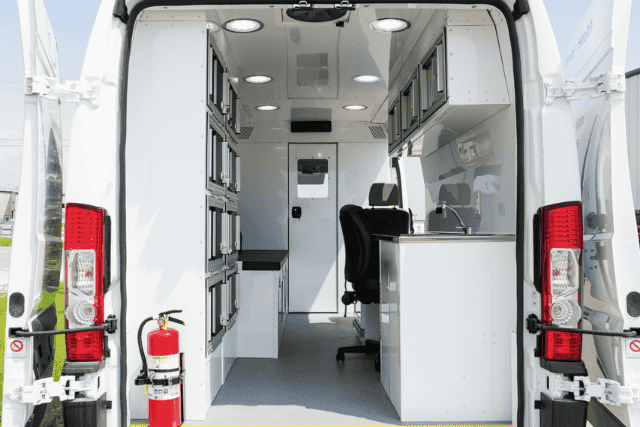
At AVAN Mobility, we work with healthcare teams that are trying to turn a big idea into something real, safe, and ready for the road. We help you think through the vehicle layout, patient flow, equipment needs, accessibility, climate control, and the small details that can make a big difference once your team is serving people in the field. Our role is to listen first, build with purpose, and help you create a mobile clinic that supports your mission from day one. If you have questions, click the button below to talk to a mobility expert.
If you’re still gathering information before that next step, these resources can help you move closer to a confident buying decision.
Recommended next reads
- How much does a mobile medical unit cost in the U.S.? This article helps you understand the full cost picture before you apply for funding or build a project budget.
- Top 10 tips on fundraising for a mobile clinic van: This is a strong next read if you’re considering donor campaigns, local partners, or community support to help fund the vehicle.
- How to choose a mobile medical van: This article helps you connect your funding plan to the right vehicle type, layout, and long-term use.
FAQ
Q: Can mobile clinics be federally funded?
A: Yes, mobile clinics can be federally funded, but the funding source has to allow vehicle, capital, or equipment costs. Some federal programs may support the mobile clinic vehicle itself, while others only fund services, staffing, or technology.
Q: What is the best funding for mobile health clinics?
A: The best funding for mobile health clinics depends on your program. Rural clinics may start with USDA funding, opioid response programs may look at settlement funds, and community health programs may explore CDBG, foundations, or donor campaigns.
Q: Can grants pay for the actual mobile clinic vehicle?
A: Some grants can pay for the actual mobile clinic vehicle, but many can’t. Always check if the funder allows capital costs, vehicle purchases, equipment, or mobile medical unit expenses before you apply.
Q: Are opioid settlement funds a good option for mobile health clinic funding?
A: They can be a good option if your mobile clinic supports opioid treatment, harm reduction, recovery, wound care, outreach, or medication-assisted treatment. The rules vary by state, county, and city.
Q: Can private foundations fund mobile clinic vehicles?
A: Yes, some private foundations and hospital foundations have funded mobile clinic vehicles. These opportunities are often local or regional, so you’ll need to look for funders that support healthcare access in your service area.
Q: Do partnerships and community support follow normal grant deadlines?
A: Usually, no. Partnerships and community support often come through donor campaigns, hospital foundations, local businesses, matching gifts, or board-approved fundraising. They’re usually built around relationships, timing, and community needs.
Q: What should you prepare before applying for funding for mobile clinics?
A: Prepare a clear care gap, service plan, vehicle budget, equipment list, operating plan, and patient impact story. Funders need to see why the mobile clinic is needed, who it will serve, and how it will improve access to care.