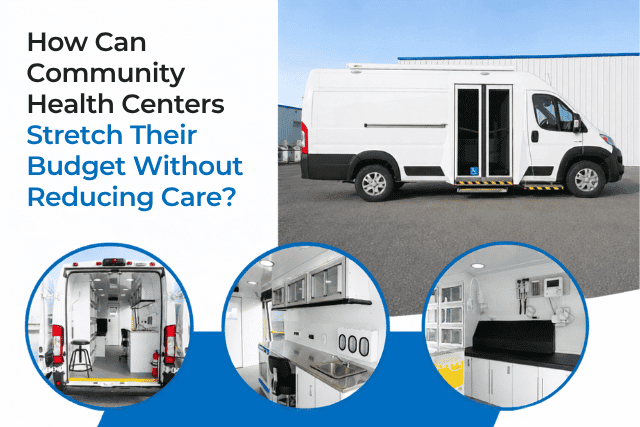
What happens when community health centers are asked to serve more people with the same budget, same staff, and same number of hours in the day? It’s already happening. Community Health Centers served nearly 34 million patients in 2024. That’s a big number, and behind it are real people waiting for care in rural towns, city neighborhoods, migrant communities, and underserved areas across the U.S.
You feel that pressure. Cutting care isn’t an option. But doing nothing can lead to longer wait times, missed visits, burned-out teams, and patients falling through the cracks. The goal is simple: stretch your budget, reach more people, and protect the level of care your community counts on.
At AVAN Mobility, we’ve spent over a decade working beside healthcare teams that have more demand than resources. We’ve built more than 180 mobile medical units for programs that can’t wait for patients to find care on their own. From CalOptima to Siskiyou County and Pacific Clinics, we’ve helped organizations turn parking lots, rural roads, school sites, and community events into practical access points for care. We’re Ford Pro Upfitter and Stellantis QPro certified, and while we’re proud of our work, we know buyers should compare their options before choosing any manufacturer.
In this article, you’ll learn how community health centers can:
- Reduce: Missed appointments and access gaps.
- Expand: Care through a mobile medical clinic.
- Support: Staff time with smarter outreach.
- Plan: A mobile medical unit budget that works harder.
How can community health centers reduce missed appointments and access gaps with a mobile clinic?
Community health centers can stretch their budget by reducing the empty appointment slots, long travel barriers, and access gaps that drain staff time and limit care. A mobile clinic helps bring basic healthcare into the patient’s community, so people can get care closer to home, work, school, or a trusted local site.
Missed appointments cost more than a blank spot on the calendar. They affect revenue, staff planning, care quality, and the patient who may get sicker before they’re seen again. Missed visits have been estimated to cost the U.S. healthcare system $50 billion each year, and that number should make any clinic leader sit up a little straighter.
For community health centers, the cost can show up in smaller ways first:
- Lost: Provider time that was already paid for.
- Delayed: Preventive care that could have avoided a bigger problem.
- Added: Follow-up work from staff who now have to rebook the visit.
- Reduced: Access for another patient who could have used that appointment.
- Increased: Risk of ER visits when care comes too late.
That’s the hard part. You understand the problem, but you can’t move your fixed clinic three hours down the road. A patient in rural West Texas, northern Maine, or the Mississippi Delta may want care and still have no simple way to reach it. Transportation, time off work, childcare, weather, gas money, and trust all play a role.
This is where a mobile health clinic can help close the gap.
How does a mobile clinic help reduce no-shows for community health centers?
A mobile clinic brings care closer to where patients already are. Think of it as a basic doctor’s office on wheels. A mobile medical clinic can support primary care, screenings, vaccines, pediatric visits, behavioral health, outreach, and follow-up care, depending on how it’s built and staffed.
Instead of asking patients to solve every barrier before they walk through your door, a mobile health unit removes a few of those barriers for them.
For example, picture a community health center in rural Arizona. Your team sees a pattern. Patients from a small town two hours away keep missing diabetes follow-ups. They’re not ignoring their health. They’re juggling work, transportation, family needs, and a long drive that turns one appointment into an all-day event.
A mobile medical unit changes the math. Your team parks at a school, library, tribal center, church, food bank, or county building once or twice a month. Patients can get checked closer to home. Staff can group visits by location. The community sees your team showing up in a familiar place.
That can lead to fewer missed visits and better use of every paid hour.
Where do access gaps cost community health centers the most?
Access gaps often cost community health centers long before they show up on a balance sheet. They show up as late-stage care, repeat ER use, staff frustration, and patients who disappear until their health gets worse.
The Rural Health Information Hub lists transportation, workforce shortages, insurance, health literacy, and stigma as common barriers to care in rural communities. Those barriers are real. They also hit budgets in quiet ways.
A mobile health van can help your team reach people who face barriers like:
- Distance: Patients live too far from your fixed clinic.
- Transportation: Public transit is limited or doesn’t exist.
- Work: Patients can’t afford to miss a full day for one visit.
- Family: Caregivers can’t travel easily with children or older adults.
- Trust: Patients feel more comfortable at a familiar community site.
- Weather: Snow, heat, flooding, or poor road conditions disrupt travel.
A mobile pediatric clinic can also help schools, Head Start programs, and rural family service partners bring care closer to children. That can support well-child visits, vaccines, hearing checks, vision checks, and basic preventive care.
The vehicle alone doesn’t solve every issue. No single tool does. But a mobile healthcare unit gives your care team more reach without opening a second building. That’s a big deal when your budget is already doing a full gymnastics routine.
How can community health centers use mobile medical services without overextending staff?
A mobile clinic van works best when it supports your current care strategy instead of creating a whole new strain on your team. The goal is to make outreach more focused, not more chaotic.
Community health centers can start with a clear plan:
- Map: Look at zip codes with high no-show rates or low visit completion.
- Group: Build routes around patient clusters, schools, shelters, or partner sites.
- Schedule: Offer repeat clinic days so the community knows when you’ll be there.
- Match: Use the mobile medical van for services that fit the local gap.
- Track: Compare missed visits, completed visits, and follow-up rates over time.
A mobile health vehicle can also support partnerships. For example, a community health center in Appalachia may work with a county health department, local school district, or food pantry. The site brings trust and foot traffic. Your mobile medical care team brings clinical support. Patients get a clearer path to care.
That’s how a mobile medical vehicle can help stretch your budget. It helps your fixed clinic reach farther without asking patients to carry the whole burden.
When fewer appointments are missed, your team protects time, funding, and patient trust. When access gaps shrink, care becomes more practical. And when care becomes more practical, your community health center can serve more people without reducing the level of care your patients deserve.
Here’s the next section, focused on smarter outreach and staff time without repeating the missed appointment section.
How can community health centers use smarter outreach to protect staff time?

Community health centers can stretch staff time by using a mobile health vehicle to group visits by area, service type, and patient need. Instead of chasing missed appointments one by one, your team can plan outreach routes that bring mobile medical services to the right communities on a set schedule.
Staff time is one of your most valuable resources. It’s also one of the easiest to lose.
Think about what happens when a rural patient misses a visit. Someone has to call them, rebook them, update their chart, adjust the provider’s schedule, and help them understand the next step. That takes time your team probably didn’t have sitting around in a nice little “free time” pile.
A mobile clinic helps shift your staff from reactive work to planned outreach. That’s a big change. It means your team can stop spending as much time trying to pull patients back into the clinic and start meeting them where care is easier to access.
How can a mobile health vehicle help your team cluster outreach by community?
A mobile health vehicle lets your community health center build a smarter route. If you’re seeing repeated gaps in certain rural areas, you can group those communities into a rotating outreach plan.
For example, your mobile clinic van might visit:
- Week 1: Two farming towns with limited public transportation.
- Week 2: A school district where families need pediatric checkups.
- Week 3: A senior housing site and a food distribution location.
- Week 4: A tribal community, migrant worker site, or county partner location.
This helps your team plan with purpose. Instead of sending staff in different directions or trying to fill random appointment gaps, you create a rhythm people can count on.
Patients learn when the mobile health van will be nearby. Partner sites can help spread the word. Your staff can prepare the right supplies, forms, equipment, and follow-up plans before the mobile medical unit leaves the clinic.
That can make outreach feel less like a scramble and more like a system.
How can mobile medical services reduce wasted staff effort?
A mobile medical clinic can help your staff do more with each trip because the day is built around a clear care goal. One visit might focus on blood pressure checks and chronic care follow-ups. Another might support vaccines, wellness visits, or basic screenings. A different route could focus on behavioral health or care navigation.
This kind of planning helps reduce wasted effort in a few practical ways:
- Fewer repeat calls: Patients know when your mobile health unit comes to their area.
- Better prep: Staff can load the mobile medical van for the day’s exact services.
- Cleaner schedules: Providers can see grouped appointments in one location.
- Stronger follow-up: Care teams can reconnect with patients during the next visit cycle.
- Less travel confusion: Patients aren’t left figuring out a long trip on their own.
A mobile healthcare unit also helps your team build trust. When patients see the same team showing up in the same community, care starts to feel more familiar. That can make conversations easier. It can also help people ask questions they may have avoided in a fixed clinic setting.
That’s where the value grows beyond the appointment itself. Your mobile medical care team becomes a steady presence, not a one-time visit.
How can community health centers use a mobile clinic without burning out staff?
A mobile clinic should make outreach more manageable, not add another layer of stress to an already full plate. The key is to design the program around your team’s real capacity.
Start with the gaps you already see. Look at where your patients live, which services they miss, and which areas cause the most scheduling friction. Then build routes around those patterns.
A practical mobile health plan may include:
- Set service days: Pick repeat days so patients and staff know the schedule.
- Partner support: Work with schools, churches, housing groups, libraries, or county offices.
- Clear visit types: Match each route to services that make sense for that location.
- Simple intake: Keep forms, consent steps, and check-in processes easy.
- Defined follow-up: Decide what happens after each visit before the day begins.
Let’s say your community health center serves several towns across rural Georgia. One area has older adults who need chronic care support. Another has families who struggle to get kids to well-child visits. A third has seasonal workers who need basic screenings and care navigation.
A mobile medical vehicle lets you plan each outreach day around those groups. Your staff doesn’t have to treat every trip like a mystery box. They know who they’re serving, what care they’re offering, and what tools they need onboard.
That kind of focus protects staff time. It also protects morale. Your team sees the impact of their work more clearly because care reaches people who may have been slipping through the cracks.
A mobile healthcare program can’t make staffing challenges vanish. No vehicle has that kind of magic under the hood. But a well-planned mobile health clinic can help your community health center use time, people, and resources with more intention.
When outreach becomes smarter, staff time goes further. And when staff time goes further, your budget gets more room to breathe.
How can community health centers stretch their budget by choosing the right services for a mobile clinic?

Community health centers can stretch their budget by choosing mobile clinic services that match the real gaps in their community. The goal isn’t to build the biggest mobile medical unit possible. It’s to build the right one, with the right services, for the people your team is trying to reach.
This is where planning gets real.
A mobile clinic can support many types of care, but that doesn’t mean every service belongs inside your first mobile medical unit. More equipment can mean more cost, more training, more space needs, and more maintenance. That may be worth it for some programs. For others, it can eat up budget before the first patient ever steps through the door.
A stronger starting point is this question:
What care are people missing because they can’t easily reach us?
That answer should guide what goes inside your mobile health clinic.
How can community health centers choose high-impact mobile clinic services?
High-impact services are the ones that help your community health center solve the most common access gaps without overloading your staff or budget.
For many programs, that could include:
- Primary care: Basic exams, follow-ups, and routine care.
- Screenings: Blood pressure, diabetes, cholesterol, vision, hearing, or wellness checks.
- Vaccines: Flu shots, childhood vaccines, or outreach during seasonal campaigns.
- Chronic care: Follow-ups for diabetes, heart health, asthma, and other ongoing needs.
- Pediatric care: Well-child visits, school-based care, and basic checks in a mobile pediatric clinic.
- Behavioral health: Private space for counseling, care navigation, and community support.
- Health education: Simple guidance on medication, prevention, nutrition, or next steps.
The right mix depends on your patients. A rural community in Montana may need chronic care check-ins and blood pressure screenings. A neighborhood in Los Angeles may need vaccines, outreach, and behavioral health support. A farming area in California’s Central Valley may need mobile medical services that support seasonal workers who can’t always visit a fixed clinic during regular hours.
That’s why your mobile medical clinic should start with the gap, not the wish list.
How can community health centers avoid overbuilding a mobile medical unit?
Overbuilding is one of the fastest ways to stretch a budget in the wrong direction. It happens when a mobile medical unit is designed around “what could we fit?” instead of “what will we use every week?”
A larger mobile medical vehicle may look impressive, but it may also need more staff, more fuel, more parking space, more storage, and more daily setup time. A smaller mobile clinic van may be more practical if your team plans to focus on basic care, outreach, vaccines, or screenings.
This doesn’t mean cheaper is always better. It means the right fit is better.
A helpful way to think about it is:
| Planning question | Why it helps your budget |
| What services will we offer most often? | Helps avoid paying for equipment that sits unused |
| How many staff will travel in the unit? | Helps match the layout to real staffing levels |
| Where will the unit park? | Helps avoid size issues at schools, housing sites, or rural roads |
| What supplies need to be stored onboard? | Helps prevent wasted space or poor workflow |
| How will patients move through the visit? | Helps protect comfort, privacy, and staff efficiency |
A mobile health unit should feel practical from day one. Staff should be able to work inside it without doing an awkward shuffle every two minutes. Patients should feel safe, respected, and comfortable. The layout should support care, not turn every visit into a puzzle with wheels.
How can mobile medical clinics be matched to different community needs?
Different communities need different types of mobile healthcare. That’s why one mobile health vehicle may look very different from another.
A community health center serving rural seniors may need a mobile medical van with space for chronic care visits, vitals, medication reviews, and care coordination. A school-based program may need a mobile pediatric clinic with a family-friendly layout and room for vaccines, hearing checks, or wellness visits. An urban outreach program may need a mobile healthcare unit that supports behavioral health, harm reduction, basic screenings, and trust-building conversations.
Here are a few examples:
- Rural communities: Chronic care follow-ups, screenings, preventive care, and care navigation.
- Schools: Pediatric visits, vaccines, vision checks, hearing checks, and wellness support.
- Senior housing: Blood pressure checks, medication support, fall-risk education, and referrals.
- Migrant worker sites: Basic exams, screenings, outreach, and health education.
- Tribal communities: Primary care access, wellness checks, behavioral health, and coordinated outreach.
- Urban neighborhoods: Mobile medical care, social support, mental health, and referral help.
This kind of matching helps your budget because the mobile clinic is built around real use. You’re not buying features for “someday.” You’re planning for the work your team already knows is needed.
How can community health centers plan for growth without overspending at the start?
A mobile health clinic doesn’t have to launch with every service your organization may offer in the future. Starting focused can be a smart move.
You might begin with vaccines, screenings, and chronic care follow-ups. Then, once demand grows, you may add behavioral health, pediatric care, or more specialized mobile medical services۔ This lets your team learn what works before adding cost.
A phased plan could look like this:
- Phase 1: Launch with core services that match the biggest access gap.
- Phase 2: Track visit volume, missed visits, patient feedback, and staff workflow.
- Phase 3: Add services that fit proven demand.
- Phase 4: Adjust routes, staffing, storage, and equipment based on real use.
That’s how a mobile medical unit can help your community health center grow with more control. You’re not guessing. You’re learning, adapting, and building around what your patients show you.
A mobile health van should help your budget work harder, not make it feel like it just joined a gym without warning. When the service mix is right, your team can reach more people, reduce waste, and deliver care in a way that fits the community.
The best mobile healthcare program starts with a simple idea: build around the gap. When your mobile medical clinic is designed around what patients truly need, every dollar has a clearer job.
Ready to stretch your community health center budget?

You came here because your community health center is trying to do more with limited funding, tight staffing, and patients who still need care close to home. That’s a hard spot to be in, especially when cutting care isn’t on the table.
After reading this article, you’ve seen how a smarter mobile health plan can help you:
- Reduce: Missed appointments and access gaps with a mobile clinic.
- Protect: Staff time through planned outreach routes.
- Choose: The right mobile medical services for your real community needs.
- Build: A mobile medical unit plan that supports growth without waste.
At AVAN Mobility, we build mobile health vehicles for teams that are ready to bring care closer to the people they serve. Our work starts with listening, because your patient needs, staffing limits, route plans, and budget goals should shape the vehicle from day one. A mobile medical clinic should feel practical for your team and respectful for every patient who steps inside. If you have questions, click the button below to talk to a mobility expert.
If you’re not ready to talk to a mobility expert yet, we have a few other resources you should check out to learn more.
Recommended next reads
- How much does a mobile medical unit cost in the U.S.? This is the best next read if you’re ready to understand pricing, budget ranges, and what can affect the final cost of a mobile medical unit.
- How to choose a mobile medical van: This article can help you compare layouts, service needs, staff workflow, and vehicle options before making a buying decision.
- Top 5 tips on how to start a mobile medical clinic: This is a helpful next step if you’re moving from early research into planning routes, services, staffing, and launch details.
FAQ
Q: How can community health centers stretch their budget without cutting care?
A: Community health centers can stretch their budget by reducing missed appointments, grouping outreach by location, and using mobile clinics to bring care closer to patients who face travel, time, or access barriers.
Q: Why do missed appointments cost community health centers money?
A: Missed appointments waste paid provider time, reduce visit volume, add rebooking work for staff, delay preventive care, and can lead to more expensive care when patients return sicker.
Q: How does a mobile clinic help reduce no-shows?
A: A mobile clinic helps reduce no-shows by bringing healthcare to schools, senior housing, rural towns, shelters, tribal centers, food banks, and other familiar places patients already use.
Q: What services can a mobile medical clinic provide?
A: A mobile medical clinic can provide primary care, screenings, vaccines, chronic care follow-ups, pediatric visits, behavioral health support, health education, and care navigation, depending on the layout and staff.
Q: How can a mobile health vehicle protect staff time?
A: A mobile health vehicle protects staff time by helping teams plan routes, group appointments, prepare supplies, and serve multiple patients in one area instead of chasing individual missed visits.
Q: Should community health centers start with a large mobile medical unit?
A: Not always. The best mobile medical unit is the one that fits your services, staffing, parking locations, storage needs, patient flow, and budget without adding unnecessary complexity.
Q: How should community health centers choose mobile clinic services?
A: Start with the biggest care gap in your community, then choose services that your team can deliver consistently, affordably, and safely inside a mobile clinic.
Q: Can a mobile clinic replace a fixed clinic?
A: A mobile clinic usually supports a fixed clinic rather than replacing it by extending care into communities where patients face barriers reaching your main location.