Updated: September 18, 2026
You’ve decided a mobile clinic could help your team bring care closer to the people you serve. Then another decision shows up: should you buy a new mobile clinic or look for a used mobile clinic for sale? Used often costs less and can get you on the road sooner. New gives you more control over condition, layout, equipment, and long-term use.
At AVAN Mobility, we’ve manufactured more than 180 mobile medical units in the past three years and worked with healthcare and outreach teams across the U.S. That gives us a close look at what happens after the purchase decision, when the unit has to work in the real world. Our work has also been recognized with the 2026 DARE Innovation Award.
This article compares new vs. used mobile clinics based on the questions that affect the buying decision most. We’ll look at condition, useful life, layout, repairs, equipment, inspection, reliability, and program fit. We’ll also show you when paying less upfront makes sense and when it creates more risk than your program should carry.
Should you buy a new or used mobile clinic for sale?
A used mobile clinic can be a strong choice when you need to launch quickly, your budget is tight, and the existing unit already fits your services. A new unit usually fits better when you’re building a long-term program that needs a specific workflow, dependable systems, accessibility, privacy, and room to grow.
Here’s the short version.
| Decision factor | Used mobile clinic | New mobile clinic |
| Upfront price | Usually lower | Usually higher |
| Availability | Often faster | Requires production time |
| Vehicle history | Previous use must be reviewed | No previous operating history |
| Interior layout | Already built | Planned around your program |
| Medical equipment | Age and condition vary | Selected for your program |
| Repairs | More unknowns | Fewer early unknowns |
| Warranty | Could be limited or expired | Stronger |
| Accessibility | Depends on existing design | Planned around your patients |
| Patient privacy | Depends on existing layout | Built into the design |
| Future changes | Limited by the current build | Easier to plan ahead |
| Best fit | Pilots, short timelines, simple programs | Long-term or specialized programs |
The mistake is treating this as a simple new-versus-used vehicle decision.
You’re buying a workplace for your staff and a care environment for patients. The chassis matters, but so do the sink, power system, HVAC, storage, accessibility, privacy, equipment, and every other part that makes the vehicle a clinic.
That’s why the cheapest listing doesn’t automatically mean the lowest-cost choice.
If you’re still deciding what type of unit your program actually needs, start with how to choose a mobile medical van before comparing individual listings.
What exactly are you buying with a used mobile clinic?
A used mobile clinic is a medical vehicle that another organization has already owned and operated. You’re buying the chassis, the medical conversion, installed systems, equipment, previous modifications, and the effects of years of use. The value depends on how well all of those pieces have been maintained and how closely they fit your program.
A used mobile medical clinic for sale could come from:
- A healthcare organization replacing an older unit
- A city, county, or public health agency
- A specialty vehicle dealer
- A nonprofit ending or changing a program
- A medical vehicle marketplace
- A private seller
Some used clinics have years of useful service left.
Others are being sold because the current owner knows repairs are coming.
That doesn’t mean you should avoid used. It means you need to understand why the unit is for sale.
Ask the seller what services were provided inside it, how often it operated, where it traveled, how it was stored, how often it idled, and what major repairs have already been completed.
A clinic that spent its life traveling paved urban routes has faced different wear than one covering remote roads in northern states.
Climate counts too.
Heat affects cooling systems and batteries. Road salt can contribute to corrosion. Long periods of idling add engine hours without adding much mileage.
Think of a used clinic as two purchases in one:
1. The vehicle that gets your team there
2. The clinical space that has to work once you arrive
You need confidence in both.
If you’re comparing several vehicle styles instead of one specific unit, five types of mobile medical vans explains how different mobile healthcare setups are used.
When does buying a used mobile clinic make sense?
A used mobile clinic makes the most sense when its existing layout already supports your services, the inspection is strong, the records are complete, and the purchase leaves enough money for updates. It’s especially useful for organizations testing a program or responding to a care gap that can’t wait through a full new-build timeline.
You need to launch quickly
Sometimes the need has already arrived.
A county could receive funding for a program that needs to start within months. A community clinic could be trying to restore services after a local provider closes. A nonprofit could be preparing an outreach program before winter.
In situations like these, an available mobile health van for sale can shorten the time between planning and serving people.
That advantage only holds if the unit is truly ready.
A clinic listed as “available now” could still need:
- Mechanical repairs
- New tires
- Generator service
- HVAC work
- Medical equipment replacement
- Plumbing repairs
- New graphics
- State inspections
- Cleaning or interior repairs
If those items take months, used stops being the fast option.
Compare the actual condition of the available unit with current mobile medical van lead times before deciding which path gets your program operating sooner.

You’re running a pilot program
Used can make sense when your organization is still learning what the program needs.
Imagine a community health center wants to test preventive screenings in three rural communities. The team knows transportation is causing missed care, but it doesn’t yet know which locations will have the strongest demand or how often each community needs service.
A used clinic could help the team learn:
- Patient demand: How many people use the service each day.
- Scheduling: Which days and locations work best.
- Workflow: How staff actually use the space.
- Storage: Which supplies need to stay on board.
- Equipment: What gets used often and what doesn’t.
- Future needs: What the next clinic should do differently.
Those lessons can be valuable before a larger long-term investment.
Used works particularly well here when the program is simple enough to use the existing layout without major changes.
The clinic already matches your workflow
This is one of the strongest reasons to buy used.
A used clinic with the right layout can save time and money because you aren’t rebuilding the space.
For example, a primary care program could find a unit that already includes:
- An exam area
- A handwashing sink
- Medical cabinets
- Work surfaces
- Shore power
- Interior lighting
- Climate control
- Patient seating
- Secure storage
That’s very different from buying a lower-priced unit and then discovering the exam bed blocks a cabinet, the staff workspace is too small, or the sink is on the wrong side of the vehicle for your workflow.
The closer the used unit is to your real needs, the more attractive the purchase becomes.
Our mobile clinic equipment guide gives you a useful list of items to compare with an existing unit.
Your budget has room after the purchase
A used clinic shouldn’t consume every available dollar.
You’ll still need money for things such as:
- Inspection: Professional review before purchase.
- Maintenance: Fluids, brakes, batteries, tires, and regular service.
- Repairs: Issues discovered during inspection or early use.
- Equipment: Replacement of worn or outdated devices.
- Branding: Removal of old graphics and installation of your own.
- Insurance: Coverage before the clinic enters service.
- Training: Helping staff understand the vehicle and installed systems.
- Updates: Changes needed to support your program.
If your budget only works when the unit needs nothing, you’re taking a big gamble.
The goal isn’t to buy used cheaply.
The goal is to buy a used clinic that still makes financial sense once it’s ready for patients.
What are the biggest advantages of buying a used mobile clinic?
The main advantages of a used mobile clinic are a lower starting price, faster availability, the ability to inspect the exact unit, and less financial commitment for a pilot program. These benefits are strongest when the clinic has a good service history and doesn’t need major changes before your team can use it.
1. Lower upfront purchase price
This is the obvious one.
A used mobile medical clinic for sale generally costs less than a comparable new unit because part of its useful life has already been used.
That can leave more of your funding available for staffing, supplies, outreach, insurance, and service delivery.
But don’t stop at the sale price.
A $40,000 difference between two vehicles can disappear quickly if the used clinic needs a generator, HVAC work, new tires, medical equipment, interior repairs, and a major retrofit.
The right comparison is:
Purchase price + required repairs + required changes + expected near-term maintenance
If you want a full discussion of mobile clinic pricing, keep that separate from this comparison and review how much a mobile medical unit costs in the U.S..
2. Faster availability
A used clinic already exists.
That can remove the chassis ordering, conversion, equipment installation, and production stages involved in building new.
For organizations facing an immediate service gap, that can be valuable.
Imagine your health center is trying to restore regular screenings in a community that lost a local provider. Every extra month can mean more people traveling farther or putting care off.
A suitable used clinic gives you another route to launch.
Again, suitable is doing a lot of work in that sentence.
3. You inspect the exact vehicle
When buying used, your team can physically inspect the clinic you’re considering.
- You can sit in it
- Walk through it
- Open cabinets
- Turn on equipment
- Drive it
- Measure spaces
- Have staff test the workflow
That gives your team a very real idea of what daily operations will feel like.
You aren’t evaluating a concept. You’re evaluating the actual unit.
4. Lower commitment for a pilot
Organizations sometimes want to prove demand before committing to a larger program.
Used can lower the barrier to that first test.
A county might want to trial mobile behavioral health outreach. A nonprofit could test basic health screenings alongside an existing homeless outreach program. A community health center could explore rotating rural clinics.
If the existing unit supports that work, used gives your team a chance to learn before designing the next stage of the program.
What are the biggest risks of buying a used mobile clinic?
The biggest risks are hidden repairs, shorter remaining life, old equipment, limited warranties, poor service records, and a layout designed for another program. These problems don’t make every used clinic a bad purchase. They make inspection and program fit far more important because you’re inheriting decisions and wear from the previous owner.
1. Hidden mechanical and conversion repairs
A clean interior can hide expensive problems.
You could find issues with:
- Heating and air conditioning
- Plumbing lines
- Water tanks
- Pumps
- Batteries
- Inverters
- Shore power
- Wiring
- Generators
- Lighting
- Flooring
- Cabinets
- Roof seals
- Doors
- Ramps or lifts
A normal mechanic can inspect the chassis, but your evaluation shouldn’t stop there.
The clinic conversion has its own systems.
A van can drive perfectly and still have a medical interior that needs thousands of dollars of work.
Our article on mobile medical vehicle battery drainage is one example of why checking the conversion systems matters before you inherit someone else’s setup.
2. Less remaining useful life
Mileage is part of the picture, but it isn’t the whole picture.
A mobile clinic can spend hours parked with the engine running while staff use climate control or onboard systems.
That means engine hours, generator hours, and operating history deserve attention too.
Ask:
- How many miles are on the chassis?
- How many engine hours are recorded?
- How many hours are on the generator?
- Was the clinic used daily or occasionally?
- Was it stored indoors?
- Did it operate in extreme heat or cold?
- Did it travel rough or unpaved roads?
- Were repairs completed on schedule?
A used clinic with complete records and careful maintenance could be a better purchase than a newer-looking vehicle with no history.
Age alone doesn’t answer the question.
Condition does.
3. The layout belongs to someone else’s program
This is where a bargain can unravel.
A unit built for vaccinations won’t necessarily work for behavioral health.
A clinic designed for basic screenings won’t automatically support primary care.
A medical testing clinic for sale could have exactly the storage and workflow one team needs while being completely wrong for another.
Major interior changes are more complicated than moving furniture.
Cabinets could hide plumbing or wiring. Equipment could be secured to the structure. Moving a sink involves water lines and wastewater. Accessibility equipment needs proper mounting and clearances.
Our article on common mobile clinic customization mistakes covers several design issues worth checking before you buy an existing conversion.
4. Older equipment
Equipment included in a used clinic needs its own review.
Check:
- Manufacturer
- Model
- Age
- Service history
- Calibration records where applicable
- Warranty status
- Parts availability
- Compatibility with your services
Medical refrigeration deserves particular attention if your program stores vaccines. The CDC provides current vaccine storage and handling guidance, including requirements around storage equipment and temperature monitoring.
A fridge that powers on isn’t enough.
The equipment has to support the work you’re planning to do.
5. Limited warranty coverage
A used clinic could have little or no remaining warranty coverage.
The chassis warranty could be expired while certain conversion components still have coverage, or the opposite could be true.
Some warranties transfer. Others don’t.
Ask for everything in writing.
If warranty support is important to your program, our mobile health van warranty guide explains the different types of coverage buyers should review.
6. Unknown previous modifications
Used medical vehicles are often modified during their lives.
Maybe a cabinet was removed, new equipment was added, wiring was changed to support another device, or someone drilled through the roof to add an antenna.
Those changes aren’t automatically a concern, but undocumented work deserves a closer look.
Ask for records of major modifications and inspect the work before purchase.
You don’t want your team discovering mystery wiring after the clinic is already in service.
When does buying a new mobile clinic make more sense?

A new mobile clinic makes more sense when your organization plans to operate for years, has a specific clinical workflow, needs strong accessibility or privacy, and can’t tolerate frequent downtime. You pay more upfront, but you gain control over how the clinic is designed and remove many unknowns tied to previous use.
Your program has a long-term future
A short pilot and a long-term care program carry different levels of risk.
Suppose your team plans to visit the same rural communities every week for the next several years.
People start planning around that schedule.
A senior knows the clinic will be there on Tuesday, parents know they can get follow-up care closer to home, and a patient who doesn’t have reliable transportation knows there’s another way to connect with care.
In that situation, reliability affects more than operations.
It affects trust.
Starting with a new chassis and new conversion systems gives your organization a cleaner maintenance starting point.
Your services need a specific workflow
A new mobile clinic lets you plan around the services you actually provide.
A behavioral health team might prioritize:
- Private conversation space
- Comfortable seating
- Sound control
- Secure storage
- Calmer lighting
A primary care team could prioritize:
- Exam space
- Medical cabinets
- A handwashing sink
- Work surfaces
- Power access
- Clinical storage
A harm reduction or outreach program could need another layout entirely.
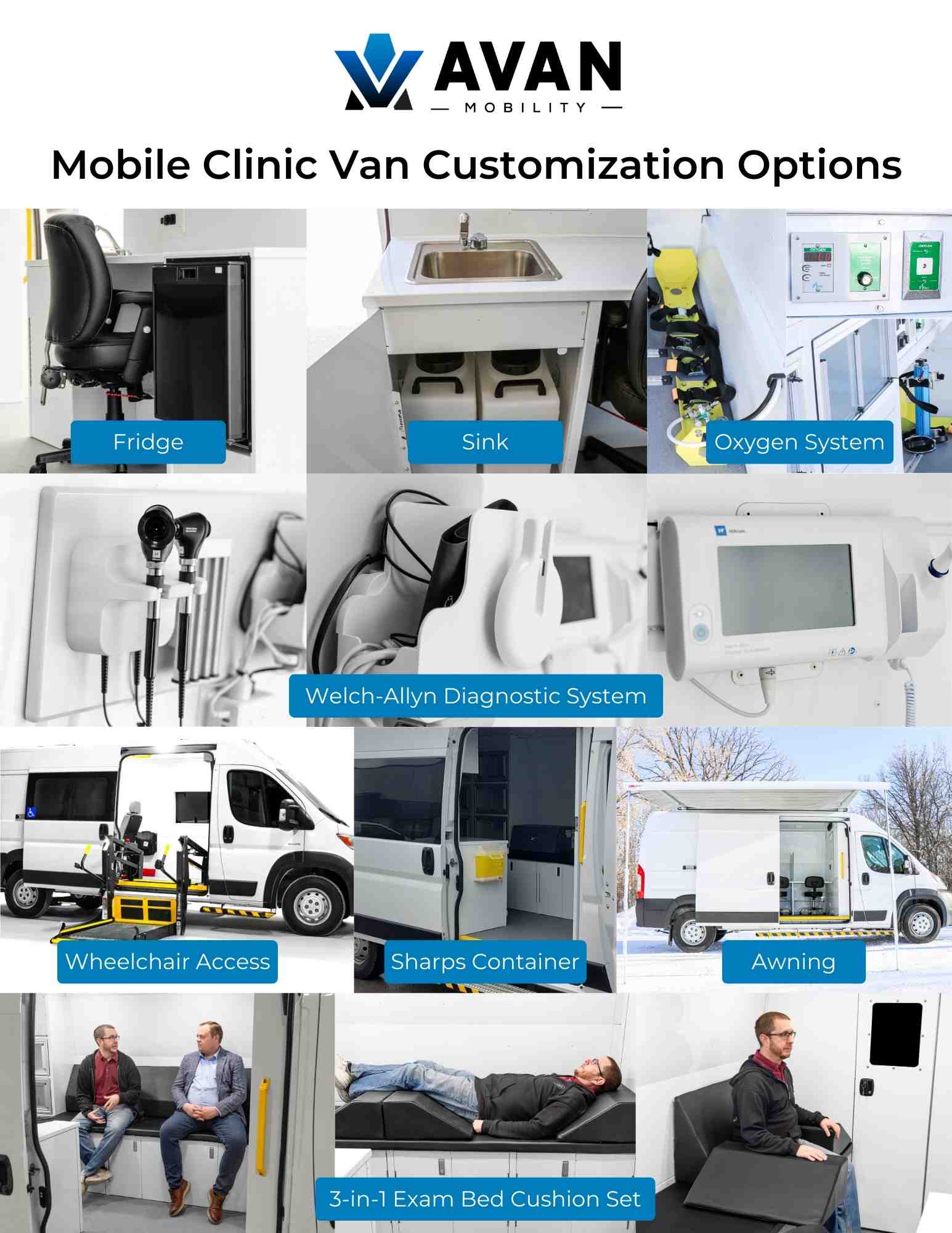
If you’re still defining those needs, mobile medical van customization explains how layouts and options are planned around different programs.
The value of new isn’t that it has more features.
It’s that the features have a reason to be there.

Accessibility is part of the program
Accessibility shouldn’t be an afterthought.
Think about the people who will actually enter the clinic.
A patient using a wheelchair, seniors who need extra time getting inside, people using walkers, a person who tires easily, and patients who already find healthcare stressful.
A new build gives your team the opportunity to plan the entrance, interior clearances, seating, patient movement, and equipment placement around those people.
A used clinic can still be accessible.
You simply have less control over how that accessibility was designed.
Privacy affects whether people use the service
Privacy can directly affect how comfortable someone feels seeking care.
That’s especially true for services involving:
- Mental health
- Substance use
- Sexual health
- Maternal health
- Chronic conditions
- Case management
- Social support
Someone might already feel nervous approaching a mobile clinic.
They shouldn’t also be wondering whether people outside can hear the conversation.
Our guide to privacy in a mobile medical vehicle goes deeper into design choices that support confidential care.
Downtime would hurt access
Every vehicle eventually needs service.
The question is what happens to your program when the clinic is unavailable.
If you have three other units, one vehicle being down is an operational problem.
If this is your only clinic serving remote communities, it can become an access problem.
Appointments get postponed.
Outreach stops.
Staff scramble for another location.
Patients wait.
This is where long-term reliability becomes part of the buying comparison rather than a maintenance topic.
What are the biggest advantages of buying a new mobile clinic?

A new mobile clinic gives you greater control over design, new equipment and systems, clearer warranty support, and a longer starting service life. These benefits become more valuable when the clinic will operate often, serve a wide area, or provide services that depend on specific equipment, accessibility, privacy, and staff workflow.
1. The clinic is built around your program
You don’t have to adapt your program to someone else’s floor plan.
Your team can think through:
- Who enters the clinic
- What happens first
- Where the patient sits
- Where staff work
- Where supplies are stored
- What equipment needs power
- How privacy is protected
- How wheelchair users move through the space
- What needs to remain secure
- What could change later
That planning affects every appointment after delivery.
A better workflow saves staff from repeating little frustrations hundreds of times.
2. You start with new systems
New doesn’t mean maintenance-free.
It means you know where the story starts:
- The chassis hasn’t spent years on someone else’s route
- The cabinets haven’t been opened thousands of times
- The wiring hasn’t been modified by three different technicians
- The generator hasn’t accumulated unknown hours
That cleaner starting point makes maintenance easier to plan.
If you want a separate look at what ongoing service involves, use our mobile medical van service guide.
3. Warranty coverage is clearer
New units typically give you a more defined warranty picture.
There can still be different warranties for the chassis, conversion, and installed equipment, so your team should understand each one.
The difference is that you start the coverage period rather than inheriting whatever is left.
For organizations running grant-funded or publicly funded programs, that predictability can also make future repair planning easier.
4. You can plan for growth
Your clinic doesn’t have to serve every future idea on day one.
Still, it helps to think ahead.
- Could you add telehealth later?
- Will you hire another staff member?
- Could your service area expand?
- Will you need more medical storage?
- Do you expect to add testing or another clinical service?
Planning for likely growth is easier before the clinic is built than after every cabinet, wire, and water line is already installed.
5. The branding starts with your organization
A mobile clinic is visible in the communities it serves.
People need to recognize who you are.
With new, your colors, graphics, organization name, contact details, and program messaging can be considered from the start rather than placed over someone else’s design.
If the clinic will be doing regular community outreach, our mobile medical vehicle wraps guide explains the practical side of vehicle graphics.
What are the disadvantages of buying a new mobile clinic?
The main downsides of buying new are a higher purchase price, a longer path to delivery, and more planning before production begins. Those drawbacks are real. The tradeoff is that much of the extra time and cost goes toward removing unknowns and building a clinic around the way your program intends to operate.
1. Higher upfront price
A new mobile medical unit for sale usually costs more than a used one.
You’re paying for a newer chassis, the conversion, equipment, labor, design work, accessibility features, electrical systems, plumbing, interior materials, and whatever options your program requires.
That can be harder for an organization with a fixed grant amount.
The question is whether the lower used price still wins after required repairs and changes are added.
Don’t compare $150,000 against $220,000 if the $150,000 unit needs another $45,000 before it works for your program.
Compare ready-to-use against ready-to-use.
2. You have to wait for production
A new clinic takes time.
There can be:
- Chassis availability
- Design review
- Production scheduling
- Conversion work
- Equipment installation
- Quality checks
- Delivery planning
That timeline can be difficult when there’s an urgent need.
It can also give your organization time to prepare the program itself.
Staffing, routes, partnerships, patient outreach, insurance, policies, and launch planning can all move forward while the vehicle is being built.
3. Your team has more decisions to make
New gives you control, but control comes with homework.
Your organization needs to think about:
- Services
- Staffing
- Patient flow
- Equipment
- Storage
- Accessibility
- Power
- Privacy
- Branding
- Future growth
That can feel like a lot if this is your first mobile program.
A structured buying process helps. Our article on the mobile medical van buying process explains what those decisions look like as a project moves forward.
How should you compare the true cost of new vs. used?
Compare what each option will cost to become ready for service, then consider what you’re likely to spend during the first several years. A used clinic has a lower purchase price in many cases, but repairs, retrofits, equipment replacement, and downtime can narrow the gap. New costs more upfront but starts with fewer unknowns.
Here’s a practical comparison.
| Cost area | Used clinic | New clinic |
| Purchase price | Usually lower | Usually higher |
| Initial mechanical work | More likely | Less likely |
| Interior modifications | Depends on existing fit | Included in initial design |
| Equipment replacement | Could be needed | Starts new |
| Branding changes | Existing graphics need removal | Planned from the start |
| Warranty | Could be limited | Starts with new coverage |
| Early downtime risk | More condition-dependent | Generally more predictable |
| Maintenance history | Must be reviewed | Starts with your organization |
| Remaining useful life | Partly used | Full starting life |
| Future retrofit need | Higher if program changes | Lower if growth is planned |
For this decision, the useful number is:
What will each option cost to become dependable, usable, and ready for the people we serve?
That’s the number your team should compare.
How much should you worry about the age of a used mobile clinic?
Age matters, but condition, maintenance, mileage, engine hours, generator hours, and previous use tell you much more. A well-maintained older mobile clinic with complete records can be a stronger purchase than a newer unit that was poorly maintained. Your goal is to estimate remaining useful life, not judge the vehicle by model year alone.
Consider these two units.
- Unit A: Seven years old, complete maintenance records, stored indoors, regularly serviced, moderate mileage, clean conversion systems.
- Unit B: Four years old, missing records, heavy idle hours, visible corrosion, unknown generator service.
Unit B is newer.
That doesn’t make it the better buy.
Look for patterns instead of one number.
Mileage
Mileage tells you how far the vehicle has traveled.
Useful, but incomplete.
Engine hours
Engine hours help reveal how much time the vehicle spent running while parked.
Mobile clinics can idle more than regular passenger vehicles, especially where HVAC or vehicle systems are being used during service.
Generator hours
A generator with heavy use could be closer to major service or replacement.
Ask for records.
Environment
A clinic used near the coast could face salt exposure.
Units from a northern state could face road salt.
A clinic operating in extreme heat puts different stress on cooling systems.
Storage
Indoor storage can protect the exterior, seals, roof, and equipment.
Ask where the unit spent its nights, not only where it spent its days.
How difficult is it to modify a used mobile clinic?
Small changes can be straightforward, but major changes can become expensive because the clinic already has walls, cabinets, wiring, plumbing, equipment, and structural mounting in place. Before buying used with plans to “fix the layout later,” get a professional estimate. A low purchase price loses its advantage when major reconstruction starts.
Simple changes could include:
- New graphics
- Different loose furniture
- Added storage accessories
- Replacement lighting
- Updated technology
- Certain equipment swaps
More involved changes include:
- Moving a sink
- Relocating electrical outlets
- Changing fixed cabinets
- Moving accessibility equipment
- Reworking walls
- Adding major power loads
- Changing HVAC
- Changing patient entry
- Installing larger medical equipment
This is one of the biggest differences between used and new.
With new, your team makes many of those choices before construction.
With used, you’re changing something that has already been engineered and installed.
Before buying a unit that needs major changes, compare the retrofit quote with the cost of starting with the right layout.
What should you inspect before buying a used mobile clinic?
Inspect the chassis, clinic conversion, power system, plumbing, HVAC, medical equipment, accessibility features, maintenance records, and patient space. A standard used-vehicle inspection isn’t enough because a mobile clinic has systems a normal mechanic doesn’t evaluate. The inspection should tell you what needs attention now and what could need attention soon.
Check the base vehicle
Review:
- Mileage: Confirm the odometer reading.
- Engine hours: Useful for understanding idle time.
- Service records: Look for consistent maintenance.
- Tires: Check age, tread, wear patterns, and cracking.
- Brakes: Review remaining life.
- Suspension: Watch for unusual wear or handling.
- Leaks: Check underneath and around the engine area.
- Rust: Look beneath the vehicle and around body seams.
- Warning lights: Don’t accept unexplained dashboard warnings.
- HVAC: Test both heating and cooling.
- Road performance: Drive the vehicle at different speeds.
Use the VIN too.
NHTSA’s VIN decoder can help you verify information tied to the vehicle.
You should also check NHTSA’s recall database to see if the VIN has open safety recalls.
Check the clinic conversion
Look beyond the driver’s seat.
Inspect:
- Flooring
- Wall panels
- Ceiling
- Cabinets
- Drawers
- Counters
- Door seals
- Windows
- Roof penetrations
- Water damage
- Interior fasteners
- Storage locks
- Handrails
Water staining deserves attention.
A small mark around the ceiling or window can point to a leak that has been happening for longer than the seller realized.
Test power systems
Turn everything on.
Check:
- Shore power
- Generator
- Inverter
- Auxiliary batteries
- Interior outlets
- USB or data ports
- Lighting
- Equipment circuits
- Exterior power connections
Run systems under load where possible.
Something powering on for 30 seconds doesn’t tell you how it performs through a full clinic day.
Test plumbing
Check:
- Sink
- Faucet
- Water pump
- Freshwater tank
- Wastewater tank
- Drain lines
- Leaks
- Tank gauges
- Winterization history
If the clinic operated in a cold climate, ask how the plumbing system was protected in winter.
Check accessibility equipment
If the clinic includes a ramp or lift, test it several times.
Check:
- Movement
- Controls
- Fasteners
- Surface condition
- Weight rating
- Manual backup procedures
- Service records
Accessibility equipment has to work when a patient arrives, not only when the vehicle is being shown to a buyer.
Review patient flow
This is the part an inspection checklist can miss.
Bring someone from the clinical team.
- Walk through an appointment.
- Where does the patient enter?
- Where do they sit?
- Can another person enter while care is taking place?
- Is there privacy?
- Can staff reach supplies without stepping around the patient?
- Can a wheelchair user move through the space?
- Can the door open safely when the clinic is parked?
The vehicle might pass every mechanical test and still be wrong for your program.
What documents should you ask for when buying used?
Ask for records that help you understand ownership, maintenance, equipment, warranties, repairs, and previous modifications. Strong documentation reduces uncertainty. Missing records don’t automatically mean the clinic is a bad purchase, but they make it harder to know how the vehicle has been maintained and what expenses could be waiting after the sale.
Request:
- Vehicle title documentation
- Maintenance history
- Repair invoices
- Chassis service records
- Generator maintenance
- Equipment manuals
- Equipment service records
- Warranty documents
- Conversion manuals
- Inspection records
- Records of previous modifications
- Accident information where available
If a seller can show years of organized service records, that tells you something about how the unit was managed.
A folder full of records isn’t very exciting.
It can be worth more than a shiny floor.
What red flags should make you reconsider a used clinic?
Walk away or investigate further when you find poor maintenance records, major water damage, heavy corrosion, electrical modifications with no documentation, failing equipment, recurring warning lights, or a layout that needs major reconstruction. One issue doesn’t always kill the deal. Several unrelated problems often signal that the low price is hiding a larger project.
Watch for:
- No service history: You have little evidence of how the vehicle was maintained.
- Water stains: These could signal roof, window, or plumbing leaks.
- Strong odors: Musty smells can point to moisture issues.
- Uneven tire wear: This can signal suspension or alignment problems.
- Unexplained wiring: Added electrical systems should be traceable.
- Weak HVAC: Patient comfort depends on reliable heating and cooling.
- Generator problems: Generator replacement can be expensive.
- Damaged cabinets: Loose interior structures can become safety concerns.
- Inoperative accessibility equipment: Repairs need to be addressed before service.
- Major layout mismatch: Retrofitting could erase the used-price advantage.
How do new and used clinics compare for different programs?
The stronger option depends on how often you’ll operate, how specialized the service is, and how much risk your team can accept. A used clinic works best when the existing layout closely matches a simple program. New becomes more valuable as the service grows more specialized, frequent, long-term, or dependent on accessibility and reliable equipment.
| Program situation | Used may fit when… | New may fit when… |
| Pilot screening program | Existing setup already works | Pilot is expected to become permanent |
| Rural healthcare route | Unit has strong records and reliable systems | Weekly service makes downtime difficult |
| Behavioral health | Space already provides real privacy | Layout needs to feel calm and purpose-built |
| Vaccine program | Refrigeration and power meet program needs | New storage and power systems are preferred |
| Tribal health program | Available unit fits routes and community needs | Long-term access and difficult travel require reliability |
| Homeless outreach | Existing design supports flexible outreach | Program needs a very specific interior setup |
| Primary care | Exam space is already appropriate | Workflow, storage, and accessibility need customization |
| Short-term grant program | Lower commitment supports the funding term | Grant is launching a permanent service |
Imagine two organizations.
One is testing weekend screenings at community events for six months. A well-maintained used clinic with the right layout could be exactly what it needs.
The other is launching weekly primary care visits across several remote communities with no backup unit.
Those organizations shouldn’t make the same buying decision.
Program risk changes the value of reliability.
What questions should your team answer before choosing?
Your team should answer how long the program will run, what services happen inside, how often the clinic operates, what downtime would cost, and what changes the used unit needs. These questions help you compare vehicles around patient care and daily operations instead of getting pulled toward whichever listing looks cheapest or newest.
Ask your team:
- How long will this program operate? A temporary pilot and a 10-year program need different thinking.
- What services happen inside? Write down the real workflow.
- How many days will the clinic operate? Heavy use increases the value of reliability.
- What happens if the unit is down? Think about the patients, not only the repair bill.
- Does the used layout fit now? Don’t rely on expensive changes later.
- What could the program become? Plan for realistic growth.
- Who will service the vehicle? Consider both chassis and conversion systems.
- What records are available? Better records reduce uncertainty.
- How much budget remains after purchase? Leave room for launch and operating needs.
- What would make us regret this purchase in two years? This question tends to start a useful conversation.
If your team is moving closer to a buying decision, preparing for an AVAN Mobility discovery call can help you organize the information a vehicle manufacturer will need.
Questions about new vs. used mobile clinics for sale

Q: Is a used mobile clinic for sale always cheaper than buying new?
A: The purchase price is usually lower, but that doesn’t always mean the total cost is lower. Add required repairs, equipment replacement, layout changes, branding, inspections, and near-term maintenance before comparing the used clinic with a new one.
Q: Should I get a used mobile clinic inspected before buying it?
A: Yes. Have the chassis inspected and review the clinic conversion, electrical system, plumbing, HVAC, accessibility equipment, generator, batteries, medical equipment, and service records before making the purchase.
Q: Can I remodel a used mobile clinic after buying it?
A: Yes, but some changes cost far more than others. Moving plumbing, fixed cabinets, wiring, accessibility equipment, walls, or major medical equipment can turn a low-priced used unit into an expensive retrofit.
Q: Does a used mobile medical clinic come with a warranty?
A: It depends on the age of the chassis, conversion, installed equipment, original warranty terms, and seller. Ask for written details and confirm which warranties still apply or transfer before you buy.
Q: Is a new mobile clinic better for a long-term healthcare program?
A: A new clinic often fits long-term programs better because your team can plan the layout around its services and start with new systems, equipment, and warranty coverage. The value increases when downtime or a poor layout would directly affect patient access.
Q: What should I compare first when looking at mobile clinics for sale?
A: Start with program fit. Define your services, patient needs, staff workflow, accessibility requirements, expected years of use, and acceptable downtime. Then compare the condition and total ready-to-use cost of each vehicle against those needs.
Choose a mobile clinic for sale around your program
You started this search because you wanted to know if buying used could save your organization money without creating a new list of problems. That’s the right question to ask before a lower purchase price starts making the decision for you.
You now have a clearer way to compare fit, condition, remaining life, risk, future use, and total investment.
A well-matched used clinic can be a practical way to launch quickly, test a service, or stretch a limited budget.
A new clinic gives you more control when people will depend on the program for years.
That difference becomes very real when you picture the patient at the other end of the decision. It could be someone in a rural community who has been driving hours for appointments. It could be a veteran who struggles with transportation, a parent looking for care closer to home, or someone who feels more comfortable meeting an outreach team in their own community.
AVAN Mobility develops mobile clinics, outreach vans, counseling units, overdose prevention vehicles, and other mobile healthcare solutions for organizations across the U.S. That range of work gives our team experience with the practical questions behind these projects, including patient flow, accessibility, storage, privacy, power, and the daily needs of healthcare staff. We use that experience to help organizations think past the vehicle itself and focus on what has to happen once the doors open.
Removing barriers to care starts with making thoughtful decisions about how care reaches people.
If you still have questions about how a new mobile clinic could fit your program, click the button below to talk to a mobility expert. The conversation can help you understand your options without committing you to a purchase.
If you’d like to keep researching first, these resources can help you move from comparison into the next stage of your decision.
Recommended videos to watch next